

Fires of the Old World XX — The Mud-Hunter
A hearthlit retelling of Arjuna, the boar, and the hunter who laughed in the mud.

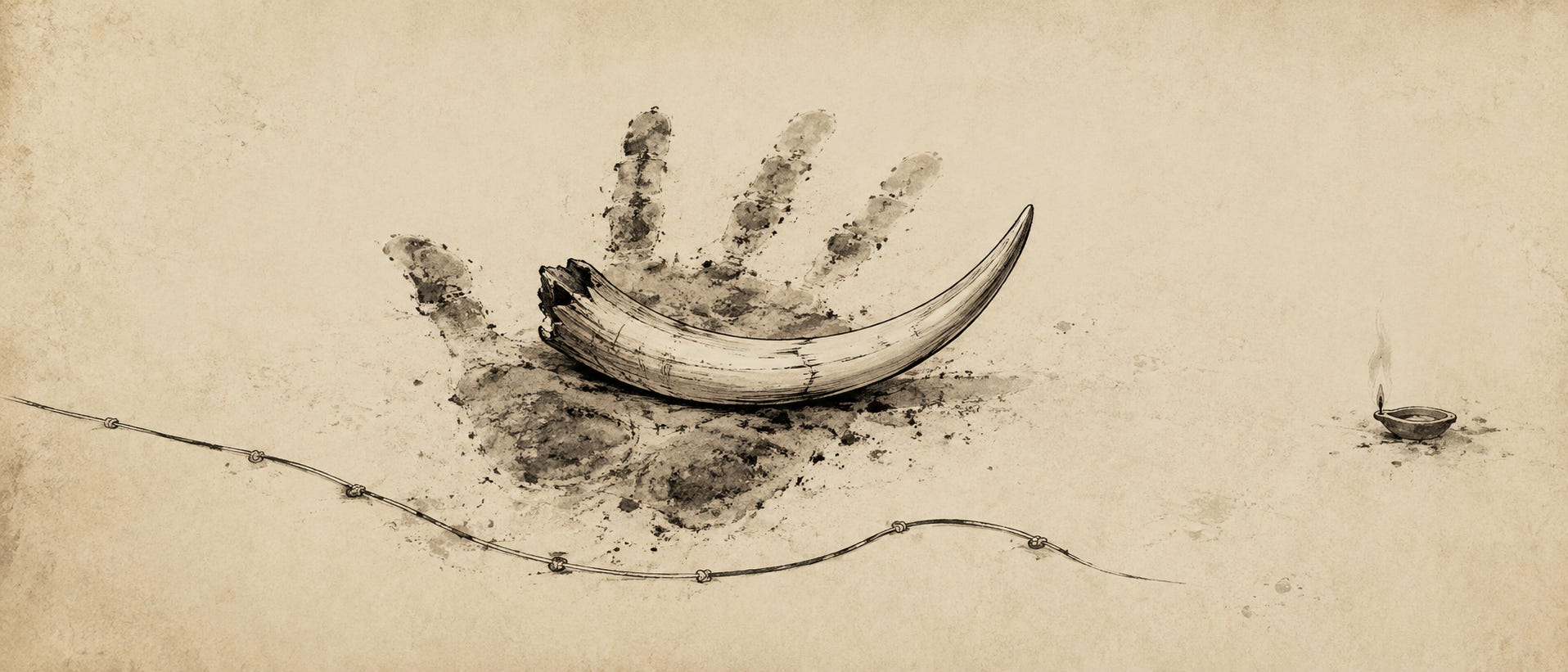
The hut stood where the last fields gave themselves to forest. Outside, wet leaves breathed in the dark. Inside, the lamp smelt of oil, the floor was cool stone, and smoke leaned softly against the roof-beams. A grandmother sat with a child beside her knee, mending a torn cloth by the light.
“Tell me of the bowman,” the child whispered.
The old woman drew the thread through once more.
“Then listen,” she said. “For this is a tale of a man who went looking for a weapon, and found mud on his hands.”
—
Arjuna left his brothers before dawn.
They were sleeping beside a thin fire. He stepped over their shadows, took up his bow, and entered the trees with the ache of many wrongs in his chest.
He did not go hunting for deer.
He did not go hunting for food.
War was waiting somewhere ahead of him, and his hands were not yet terrible enough.
So he climbed.
The forest took him higher each day. Roots crossed the path like sleeping serpents. Thorns caught at his ankles. Rain entered his hair and ran cold down his back. He ate bitter fruit, leaves, and water cupped in stone.
At night he stood on one leg with his arms lifted.
By day he fixed his mind upon the Lord of the Mountain, the one whose throat held poison, whose hair held the river, whose silence made even the winds sit down.
He asked for a weapon no man could answer.
His stomach hollowed.
His pride did not.
The forest listened.
It did not answer.
—
On the seventh day, a boar came crashing through the undergrowth.
It was huge, black with mud, and its eyes were red as banked embers. Its tusks tore the earth as it ran. Trees shook. Birds lifted. Stones leapt under its feet.
Arjuna turned.
The boar was coming straight for him.
He drew one arrow.
At the same moment, from the other side of the clearing, another bowstring sang.
Two arrows flew.
The boar fell.
Dust rose. Leaves trembled. The smell of torn earth filled the air.
Arjuna lowered his bow.
Across the clearing stood a hunter.
He was dark with forest mud from shoulder to heel. His hair was knotted roughly. His chest was broad. Around him stood mountain folk, men and women with baskets, skins, dogs, and bright teeth. A woman beside him held a little lamp in her hand, though the day had already come.
The hunter looked at the fallen boar and grinned.
“My shot,” he said.
Arjuna’s fingers tightened on his bow.
“I loosed first.”
“The boar fell to my arrow.”
“It charged at me.”
“It died for me.”
The mountain folk laughed, not cruelly, but with the free laughter of those who knew the forest better than kings.
Only the woman with the lamp did not laugh. She shaded the flame with one hand and watched Arjuna’s feet in the mud.
Arjuna stepped forward.
“I am no village boy to be mocked.”
“No,” said the hunter. “You are a hungry prince with clean hands.”
The words struck harder than insult.
Arjuna looked down.
Mud had dried across his palms. Blood from a thorn had darkened one finger. The forest had already taken some of him, and still he stood as if he had arrived untouched.
The hunter bent and snapped a tusk from the fallen boar. He tossed it once in his hand.
“Take your pride,” he said. “It has a sharp end.”
Arjuna’s face burned.
“I will take what is mine.”
“Then take it.”
—
They fought first with words.
The hunter’s words were stones thrown into shallow water. Arjuna’s were arrows polished for a royal court. But the stones landed, and the arrows missed.
They fought next with arrows.
Arjuna sent shafts as quick as rain. They vanished into the hunter’s body as if into smoke. The hunter yawned, scratched mud from his shoulder, and shot back lazily.
One arrow cut the string from Arjuna’s bow.
Another struck the knot of his hair.
Another pinned the edge of his cloth to a tree.
The mountain folk clapped their hands.
Arjuna seized a sword.
The hunter broke it with a laugh.
Arjuna lifted a spear.
The hunter caught it and used it as a walking stick.
Then Arjuna ran forward and struck him with his fists.
The hunter stood like a hill in rain.
Arjuna leapt upon him.
They rolled in the mud together.
Prince and hunter turned over roots, stones, leaves, and the broken tusk of the boar. Arjuna’s shoulder struck the ground. His mouth filled with earth. His knees tore. Mud entered his hair, his ears, the space beneath his nails.
Still he fought.
The hunter’s laughter shook against him like thunder under the soil.
At last Arjuna was thrown aside.
He lay on his back, gasping. Above him, leaves moved against a pale sky. His bow was broken. His sword was broken. His breath came hard. His pride hurt more than his ribs.
The hunter stood over him.
“Is that all?”
Arjuna rose slowly.
His legs shook.
Again he came.
Again he was thrown down.
A third time he rose, with mud on his face and blood at his lip, and the forest grew very still around him.
This time he did not reach for a weapon.
He gathered wet clay in both hands.
Near the root of a tree, he shaped a small mound. He pressed it smooth with his thumbs. He set leaves around it. From the grass, he plucked a few wild flowers bruised by the fight. One by one, he placed them upon the mound.
Then he bowed.
The mud cooled beneath his forehead.
When he opened his eyes, the flowers were gone.
They were lying in the hunter’s hair.
Arjuna froze.
The hunter’s smile had changed.
The laughter around him softened. The dogs were silent. The woman with the lamp held it steady, and its small flame did not move in the wind.
The hunter lifted the boar’s broken tusk and placed it in Arjuna’s hand.
“You are hunting a god. Admit it.”
The words entered him like rain entering dry ground.
Arjuna looked at the mud on the hunter’s body.
He looked at the flowers in his hair.
He looked at the little flame that did not tremble.
Then the name rose in him.
It rose as breath.
“Shiva.”
The forest bowed before Arjuna did.
—
The hunter was gone.
In his place stood the great Lord, ash-bright and terrible, gentle as evening smoke and high as the mountain behind the clouds. The crescent moon rested in his hair. The river stirred there also, hidden and shining. Serpents lay across him like living cords. His eyes held fire, sleep, and the last silence after all drums have ceased.
Beside him stood the Mother, no longer a hunter’s wife, no longer carrying a village lamp, yet still holding light as if it were a household thing.
Arjuna fell with his forehead in the mud.
The broken tusk was still in his hand.
Shiva touched him.
The ache left his ribs. The cut at his lip cooled. His torn knees stopped trembling, though the mud remained.
“You came for a weapon,” said the Lord.
Arjuna did not lift his head.
“Yes.”
“You asked as a warrior.”
“Yes.”
“You fought as a prince.”
“Yes.”
“You fell as a man.”
Arjuna held the tusk tighter.
“Yes.”
Shiva’s voice grew soft.
“Then rise.”
Arjuna rose.
A weapon came into the clearing.
No hand carried it. No fire forged it before him. It arrived like a vow that had been waiting for breath.
The grass lay flat around it.
The leaves turned pale underneath.
The little lamp in the Mother’s hand bent its flame towards the ground.
Shiva gave the weapon to Arjuna.
“Hold it only when the world itself must answer,” he said.
Arjuna received it with both hands.
It was lighter than a reed.
It was heavier than a mountain.
Cold ran from the weapon into his palms. In its edge he saw a field before battle: men still speaking ordinary words, one horse shaking flies from its mane, a cup overturned beside a wheel.
His fingers trembled.
Something in his chest snapped, quiet as a measuring cord giving way.
He bowed again.
This bow was lower.
It was also freer.
When he looked up, the Lord and the Mother were already turning back into forest light. The mountain folk had become shadows between trees. The dogs were wind.
Before the lamp vanished, the Mother tilted it once towards Arjuna’s open hand.
Then the flame became a gold point between leaves.
Only the mud remained.
Only the tusk remained.
Only the weapon, hidden now beyond sight, burned softly in his keeping.
—
Arjuna went down the mountain slowly.
The path that had opened for his hunger did not open for his return. Stones slipped beneath his feet. Once, a thorn tore the skin of his heel. Once, thirst made his tongue thick. Once, fear tightened in him when he thought of the weapon sleeping near his heart.
He walked with care.
At a stream, he knelt and washed his face.
The mud left his cheeks, his eyes, his mouth. It stayed in the lines of his palms. He looked at them for a long while.
Then he placed the boar’s tusk in the fold of his cloth.
Its curve pressed against him as he walked.
When he reached his brothers, the fire was low.
They saw the change in him before they saw anything else.
One brother gave him water. Another brought him food. Another looked at the dried mud beneath his nails and said nothing.
Arjuna sat among them.
For a while he listened to the small sounds of men who had not yet gone to war: the crack of twigs, the swallow of water, the breath taken before sleep.
The forest did not praise him.
The stars did not bend.
Somewhere in the dark, a boar’s broken body was returning to earth. Somewhere higher still, laughter moved through the mountain like thunder that had chosen not to strike.
Arjuna opened his hand.
The white tusk lay across his palm, curved and hard and plain.
He remembered the hunter’s grin.
He remembered the mud.
He remembered the flowers in the god’s hair.
Then he closed his hand again and sat quietly until dawn.
—
The grandmother’s needle stopped.
The child had not moved for a long time. The lamp between them burned lower now. Outside, the wet leaves breathed in the dark, and cool air touched the stone floor.
“Was the hunter angry?” the child asked.
The old woman smiled and folded the mended cloth.
“No,” she said. “He was laughing too hard for anger.”
The child looked at his own small hands. A smudge of soot lay near one thumb.
The grandmother took the cloth and wiped it away.
Then she turned his palm upward and left it open on his knee.
The lamp gave one small sound in the oil.
The room held its breath.
Then the flame steadied, and the child slept beside the stone.
For paid subscribers, I have added a Workroom note on the making of this tale: the mud that became its centre, the line that nearly explained too much, and the revisions that let the hunter’s laughter carry the god.