

Fires of the Old World XVI —The Wrestling Hall
A hearthlit retelling of Krishna, Kamsa, the broken bell, and the calm hand that ends fear without hate.

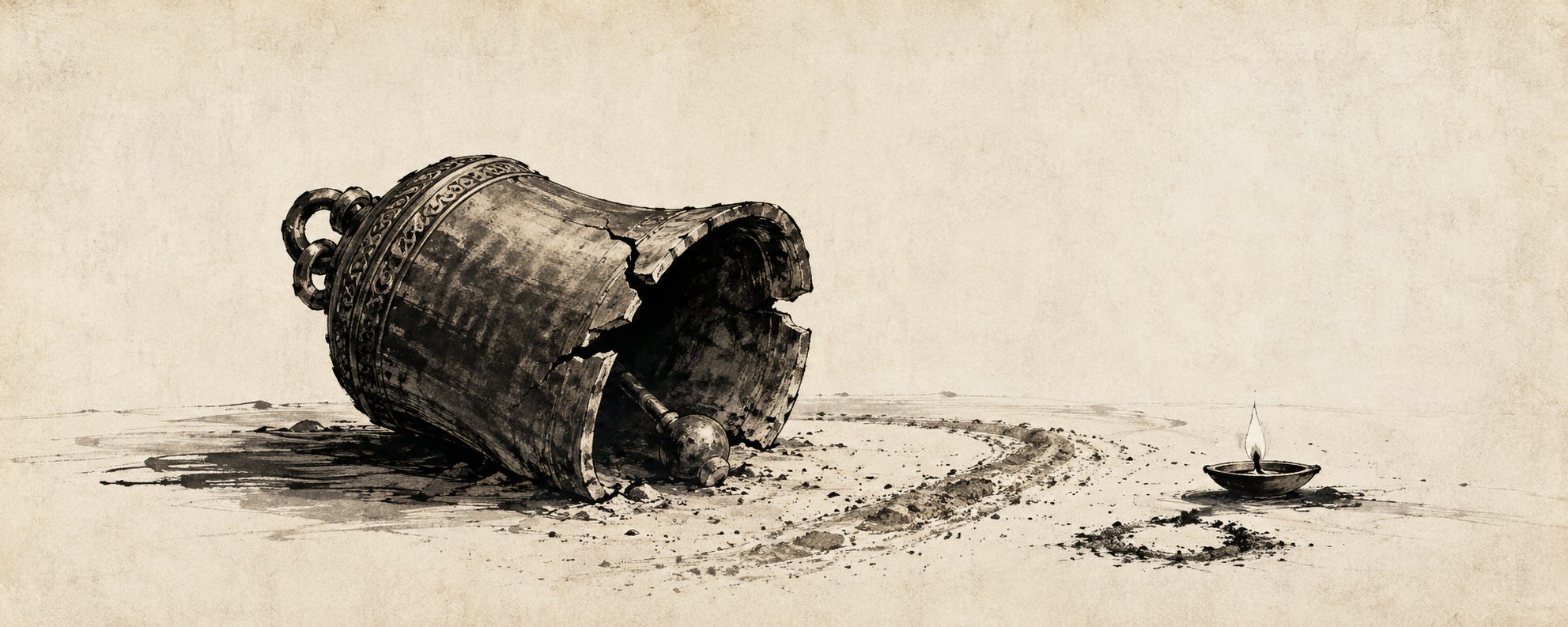
There was once a hall in Mathura where the floor had been washed before dawn, and still the dust would not stay away.
Listen.
The old woman by the lamp lowered her voice, and the child beside her drew his knees under the blanket. Outside, the night smelt of wet earth. Inside, there was warm oil, cool stone, and the faint smoke of the wick. The old woman touched the child’s hair once, as if settling a small bird.
“Tonight,” she said, “we speak of a king who feared a boy.”
In Mathura, Kamsa sat above the wrestling floor.
He had built the hall wide enough for shouting to rise like storm-clouds. Pillars stood in rows. Garlands hung from their hooks. Lamps burned along the walls, and the sand below had been raked smooth by men who did not look up.
At the northern side, high on a carved seat, Kamsa leaned with one hand on the arm of his throne.
Behind him hung a broken bell.
It had cracked years before, when it was rung too hard after one of his victories. No smith had been allowed to mend it. Kamsa liked the sound it made now: dull, split, unable to sing. When it struck, the hall did not rejoice. It shuddered.
That morning he ordered it rung.
The clapper moved.
The broken bell gave its wounded voice.
People entered quietly after that.
They came because the king had commanded them. They came because no one knew what refusal might cost. Women drew their shawls close. Merchants kept their eyes lowered. Old men sat with fingers pressed into their knees. Children were held against their mothers’ sides, feeling the quick hearts beneath cloth.
On the floor below, the wrestlers waited.
Chanura stood like a gate made of flesh. Mushtika rolled his shoulders, and the cords in his arms moved under skin. They had thrown many men down before. They had been fed and praised for making fear useful.
Kamsa watched them and felt better.
Strength was a wall.
Command was a lock.
Fear was a measuring cord stretched across every life in Mathura, and he held the end of it.
Then the boys came in.
They did not come with armour. They did not come with drums. They came as cowherds come from the road: dusty feet, bright eyes, hair touched by wind, shoulders loose from walking. One was fair and strong, his step broad and certain. The other was dark, slender, and calm.
Krishna.
But in that hall few dared breathe the name.
Some remembered whispers: the child hidden from death, the child carried through storm, the child who had danced among calves and trees, the child for whom danger had worn many masks and failed each time.
Kamsa remembered more.
He remembered a baby he had tried to kill before the child could become a child. He remembered sleep broken by dreams of a wheel, a serpent coil, a lotus opening in darkness. He remembered messengers sent to the cowherd land, and the silence that returned in their place.
Yet when the dark boy walked into the hall, he looked almost ordinary.
That made the king colder.
Krishna paused at the edge of the sand. His toes touched the pale floor. Balarama stood beside him, smiling a little, as if the great hall were only another field and the gathered crowd another herd watching rain approach.
A murmur passed through the people.
Kamsa lifted his hand.
The murmur died.
The broken bell moved once more above him.
Its cracked note fell over the hall.
Chanura stepped forward.
“Cowherd,” he said, “the king has heard of your strength. Come, wrestle with me.”
His voice was smooth. His hands were not. His fingers flexed. His neck was thick as a young tree. He looked at Krishna as a butcher looks at a goat brought too near the knife.
Some among the people stirred.
“These are boys,” an old man whispered.
A guard struck his staff on the floor.
Silence returned.
Krishna looked up at Chanura.
His face did not harden. He did not boast. He did not ask for mercy. He only bent, took a pinch of sand between his fingers, and rubbed it across his palms.
The grains caught in the lines of his skin.
Balarama did the same.
That was all.
The hall seemed to lean closer.
Chanura circled first.
He moved heavily, stamping the sand into little clouds. Krishna moved with him, light, watchful, unreadable. The great wrestler reached. Krishna was no longer there. He reached again. The boy turned. A hand brushed a wrist. A foot slid. Sand whispered.
Then Chanura lunged.
His arms closed around Krishna like a gate.
For one breath, the boy vanished inside the wrestler’s hold. Chanura’s muscles tightened. His teeth showed. He tried to crush what he had caught.
Krishna stood within the grip as a lamp stands within wind.
Still burning.
Then his hand moved.
It found Chanura’s arm, closed, and turned him.
The great body shifted.
The sand broke under their feet.
Chanura felt the change before anyone saw it. His strength, which had always moved outward, met something it could not measure. He pushed. The boy yielded. He pulled. The boy came with him. He struck. The boy was elsewhere.
Once, the sand turned.
Twice, the wrestler’s breath broke.
A third time, Krishna was elsewhere.
Mushtika entered then, roaring toward Balarama.
Balarama laughed.
It was not mockery. It was the sound of a river striking stone and knowing it will pass.
The fair boy met him with open hands. The floor shook beneath them. Mushtika struck. Balarama stepped close, and the blow lost its thunder. They grappled shoulder to shoulder, turning through the sand while dust rose around their legs.
The hall became two storms.
Kamsa gripped the throne-arm until his nails bent.
He no longer watched the garlands, or the guards, or the priests, or the high doors where sunlight entered in pale bars. He watched the dark boy.
Krishna’s face had not changed.
Men rage when they are afraid. Heroes blaze when they are praised. Warriors show their teeth. Children cry out. Even kings, alone in darkness, whisper bargains to whatever listens.
But Krishna wrestled as if he had come to return a borrowed thing.
Chanura began to tire.
His breath grew rough. His feet dragged. Sand stuck to sweat along his arms. He bent, seized Krishna with both hands, and lifted.
The hall gasped.
For one long breath, the boy’s feet left the earth.
Then Krishna turned in the air.
He came down standing.
Chanura stared.
In that instant, some old courage entered the crowd. Not shouting. Not rebellion. Only a small straightening of backs. A child loosened his fingers from his mother’s shawl. A woman lifted her eyes.
Kamsa saw it.
A king can bear many enemies.
He cannot bear the first breath of the unafraid.
“End it,” he said.
His voice cracked like the bell.
Chanura heard. Mushtika heard. The guards heard. Even the lamps seemed to draw inward.
Chanura gathered what remained of his strength. He struck low, then high, then drove forward with his whole weight. Krishna let him come.
The two met in the centre of the sand.
The sound was not loud.
A body losing its pride makes a smaller sound than men expect.
Chanura staggered.
Krishna’s hand had closed on him.
Without hate.
Not anger. Not delight. Not vengeance wearing a crown of light. Only one calm hand, sure as dawn on stone.
Chanura fell.
Across the sand, Balarama turned Mushtika’s force back upon him. The great wrestler dropped to his knees. His arms, which had been so terrible, hung empty at his sides. Then he too sank down, and the dust accepted him.
No one cheered.
Fear had lived in them too long to leave quickly.
The wrestlers lay still. The boys stood breathing, their bodies marked with sand and effort. Balarama wiped his mouth with the back of his wrist. Krishna looked up.
At Kamsa.
The king rose.
For a heartbeat he was not the man on the throne, not the lord of Mathura, not the one whose command had bent the city into silence.
He was only a frightened man standing under a broken bell.
“Seize them,” he said.
No one moved.
“Bind the cowherds. Drive out their people. Kill the old man who calls himself their father. Take their kin.”
The words flew from him like black birds startled from a roof.
Still no one moved.
Krishna stepped toward the throne.
The first step was quiet.
The second crossed the sand.
The third entered the place where command had always been enough.
Kamsa looked at him then, truly looked.
Not at the dust on his feet.
Not at the boy’s arm, marked where Chanura had gripped him.
Not at the peacock-feather brightness in his hair, not at the curve of his mouth, not at the eyes that held no courtly fear.
He looked, and all the years he had spent killing sleep returned to him.
The hidden child.
The dark river.
The undone traps.
The dreams of wheel and serpent.
The voice he had tried to bury under orders.
He knew the boy. Too late.
The hall narrowed to the space between them.
Kamsa reached for his sword.
His hand slipped.
The hilt had been polished by servants until it shone, but his palm was damp. He caught it on the second try and drew the blade halfway before Krishna reached the throne.
No guard raised a spear.
No drum sounded.
The broken bell trembled above them, though no hand touched it.
Krishna sprang.
He did not fly like a god in a painted tale. He moved as a boy moves when the body knows the path before thought can name it. One foot touched the carved edge. One hand caught the king’s cloth. The sword clattered away.
Kamsa struck at him with both fists.
Krishna took the blows.
They landed on shoulder, arm, side. They were the blows of a man who had ruled by fear and found fear leaving the room. He struck again. Krishna caught his wrist.
There are hands that close to possess.
There are hands that close to punish.
There are hands that close an ending.
Krishna’s hand closed.
Kamsa went still.
Not dead at once. Not spared. Stilled.
His crown slipped sideways. His breath came once, hard and small, as if it had found a door too narrow for pride. Krishna drew him down from the throne, away from the high seat, away from the broken bell, down to the sand where every wrestler had stood as mortal.
The king touched the floor.
The hall watched.
Kamsa’s fingers opened.
Ash from the lamp-wicks drifted in the high air and settled near his hand.
Then the broken bell rang by itself.
Not loudly.
Not whole.
One cracked note moved through the hall and failed into silence.
After that, the people began to breathe.
It did not happen like a festival. No one knew the shape of freedom yet. An old woman covered her face and wept into her shawl. A guard lowered his spear until its point touched the ground. Somewhere near the back, a child laughed once, then stopped, astonished by the sound.
Balarama came to stand beside Krishna.
The two brothers looked very young in that vast hall.
Dust on their legs.
Sand on their palms.
Breath still moving hard in their chests.
Then the shouting came.
It rose first as a murmur, then as a cry, then as something the broken bell could not break. Not triumph. Not blood-hunger. Not the roar Kamsa had loved.
Relief had a different sound.
Like a door unbarred from inside.
Krishna did not climb back to the throne. He did not sit where fear had sat. He looked once at the fallen king, and there was no hatred in him.
That frightened some people more than anger would have done.
It comforted others for the rest of their lives.
The old prison doors were opened before sunset.
Those who had been kept in darkness came slowly into the light. Ankles marked by iron met the dust of the courtyard. Hands touched faces. Names were spoken and answered.
Kamsa’s father was brought out too, thin with captivity, his hair white, his steps unsteady.
Krishna bowed to him.
As a child bows before age.
The old king touched Krishna’s head, and his fingers trembled.
Then the servants took down the broken bell.
It was heavier than they expected. Four men bore it out between them, and when it passed through the doorway, its cracked rim brushed the stone and gave one last dull sound.
No one hung it again.
That evening, the wrestling sand was swept. The garlands were removed. The throne was left empty through the night.
But one lamp remained burning.
Its flame was small and steady.
People came quietly to look at it. Some brought lotus flowers. Some brought nothing. A woman who had lost two sons stood there until the wick shortened and her shadow softened on the wall. A child placed one coil-shaped scale from a toy serpent beside the lamp, because he had nothing else and wanted to give something.
No one laughed.
The city slept differently that night.
Not without grief. Not without the memory of what had been done. But the air had changed. The measuring cord of fear had slipped from Kamsa’s dead hand, and no one wished to pick it up.
Far from Mathura, cattle shifted in their sleep.
River-water moved under stars.
And in the houses of the city, mothers touched their children’s foreheads and found them warm, alive, near.
—
The old woman beside the lamp stopped speaking.
For a while the child said nothing. The wick leaned and rose again. Outside, the wet earth breathed its dark smell through the cracks of the door.
At last the child asked, “Was Krishna angry?”
The old woman looked at the flame for a long time.
“No,” she said.
And because there was nothing more to add, she drew the blanket higher over the child’s shoulder.
The room was very quiet now. The story had used up the storm and left only the small work of breathing. On the floor, beside the lamp, a little ash had fallen from the wick.
The old woman pressed it flat with one careful finger, and the child watched the mark darken the stone.