

Fires of the Old World XV — The Serpent-River Dance
A hearthlit retelling of Krishna, Kaliya, and the poisoned river that learned to carry the moon again.

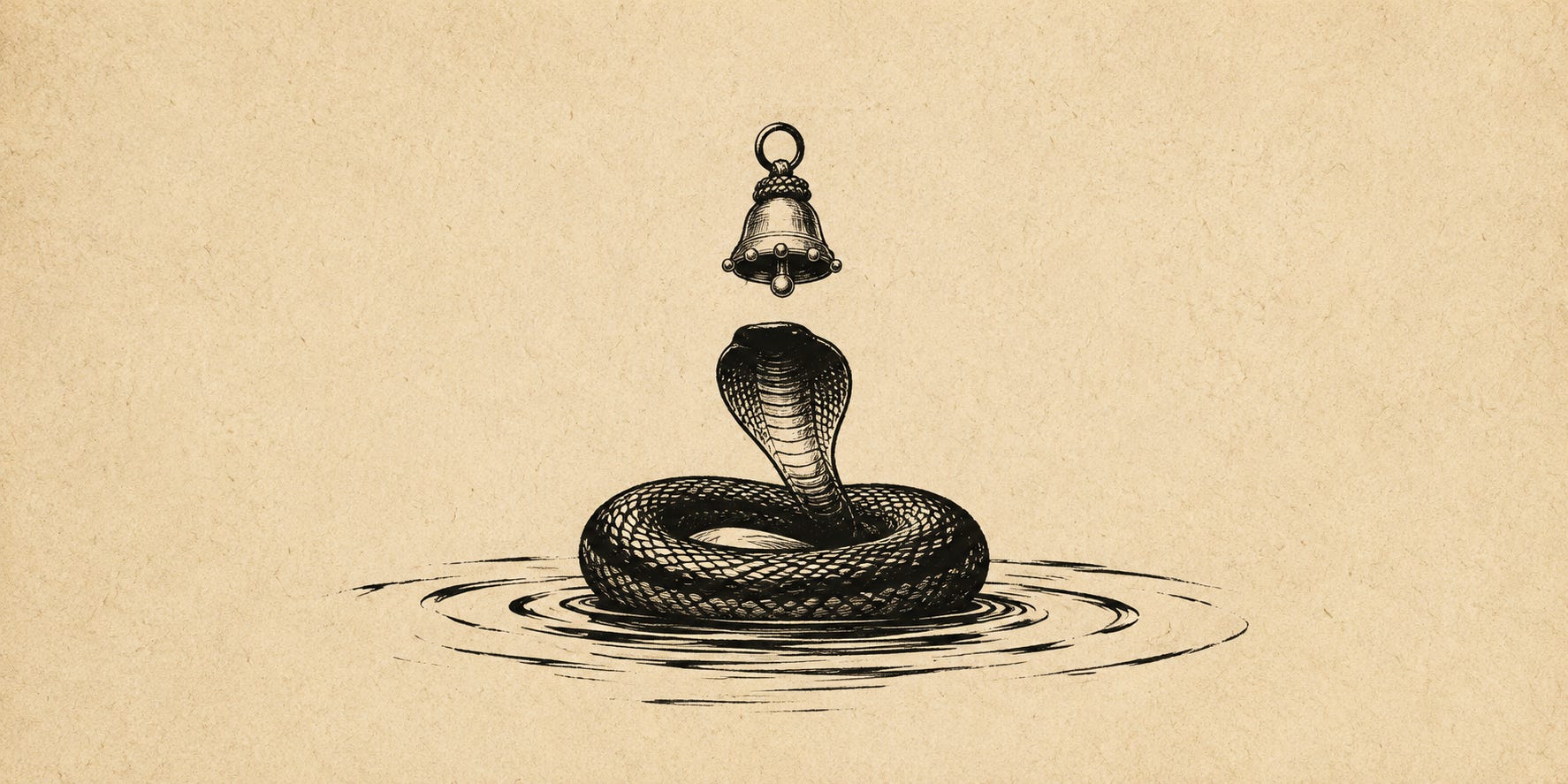
The grandmother told it when the oil lamp burned low.
Outside, the river breathed in the dark. The cattle bells were still. A child lay with his cheek against a folded cloth, smelling warm milk, lamp-smoke, and the cool night air that slipped beneath the door.
“Listen,” the grandmother said.
The child listened.
Far away, where the river bent through the pasture land, there had once been a pool no one touched. Birds would not settle near it. Cows lowered their heads, then stepped back. Even the wind seemed to pass that water with its mouth closed.
In that pool lived Kaliya, the serpent.
He had come with his coils and his anger. Long before, fear had driven him from other waters. A shadow with wings had hunted him across the sky. Since then, wherever he rested, he made a fortress of poison.
He wound himself through the deep place where the river slowed, and there he stayed.
His poison rose through the water. It darkened the reeds. It silvered the stones. It made the river smell of bitter leaves and old iron.
The people of the village warned their children.
Do not go near that bend.
Do not throw a flower there.
Do not let the calves wander close.
And for a while, the children obeyed.
—
But children are made of feet.
One morning, when the sun was young and the grass still held dew, Krishna went with the cowherd boys to the river meadows. They carried their lunches in cloth bundles. They shouted to one another across the fields. They ran barefoot through the dust, with the calves trotting after them and the day widening in gold.
Krishna walked among them with a flute tucked at his waist.
His hair was dark as rain-water. His smile came and went like light on a leaf. Around his ankle, a little bell sounded whenever he ran.
No one who loved him could keep fear in the same room for long.
They played until their throats were dry. They wrestled in the grass. They threw sticks. They chased the calves towards shade.
Then one boy saw water shining through the trees.
He forgot the warnings.
Another followed him.
Then another.
The calves were thirstier than memory. They pushed through the reeds, lowered their soft noses, and drank.
The boys drank after them.
For one moment, the meadow held its breath.
Then the calves staggered.
The boys dropped to the ground as if sleep had struck them all at once.
The cloth bundles fell open. Fruit rolled into the dust. A little hand lay palm-up beside the riverbank.
Krishna turned.
The sound went out of the morning.
He came quickly, but without panic. He knelt among them. He touched one calf between the eyes. He touched one boy’s chest. He looked at the darkened pool where the water moved though no wind touched it.
Then he smiled very softly.
Life returned as if a door had opened inside the body.
The calves shuddered and lifted their heads. The boys coughed, blinked, and sat up, bewildered beneath the trees.
One began to cry.
Another clutched Krishna’s arm.
A third stared at the river and whispered, “Do not go.”
Krishna stood.
The river bent before him, black and still.
—
There was a kadamba tree near the poisoned pool.
Its roots held the bank like fingers. Its branches leaned over the water. No bird sat in it now, and no child climbed it. The leaves hung dull and heavy, as if they had forgotten rain.
Krishna went to the tree.
The boys called after him.
He did not turn back.
He tightened the cloth at his waist. He set his foot against the bark. Up he climbed, brown limbs flashing between the leaves, ankle-bell ringing once, twice, three times.
At the highest branch he paused.
The river below him was dark as a closed eye.
Then Krishna leapt.
He struck the water with a sound that ran through the bank, through the reeds, through every listening root. The pool burst upward. Poisoned spray flew into the air. The boys stumbled back, covering their faces.
Deep below, Kaliya woke.
His coils stirred in the blackness. Mud lifted. Fish fled into shallower water. The river rolled over itself as the serpent rose.
First came the ripple.
Then the scale.
Then the hood.
Kaliya lifted himself from the river in a tower of living darkness. His eyes burned with the anger of one who had made fear into a home. Around him, the poisoned water hissed.
He saw the boy.
Small.
Barefoot.
Smiling.
The serpent struck.
Krishna moved aside.
Kaliya struck again.
Krishna vanished beneath the splash, then rose behind him, laughing.
The third time, the serpent threw his coils around the boy.
The river tightened.
The boys screamed.
Across the pasture, the cows lifted their heads. In the village, women stopped grinding grain. Mothers looked towards the river before anyone had spoken.
Something had changed in the air.
At the pool, Kaliya bound Krishna in coil after coil. Black water climbed around them. The serpent squeezed until the reeds bent low and the banks began to crumble.
The boys ran.
They ran to the village with mud on their legs and terror in their mouths.
“Krishna,” they cried.
“River.”
“Serpent.”
That was enough.
—
The village emptied.
Mothers came first. Fathers followed. The old came leaning on sticks. The young came stumbling through the dust. Cows broke their tethers and moved lowing towards the river, their eyes wide and wet.
Yashoda ran as one runs when the heart has gone ahead of the body.
At the bank she saw the poisoned pool.
She saw Kaliya rising.
She saw the coils.
For a moment, she did not see her son.
Her knees weakened. Hands caught her. Someone called his name. Someone prayed. Someone tried to step forward and was pulled back from the black water.
The serpent tightened again.
The river darkened under his body.
Then Krishna opened his eyes.
He had been still inside the coils. Still as a flame before it rises. Still as a child pretending sleep when he is listening to everything.
Kaliya felt the change first.
The body inside his coils did not struggle. It did not strain. It simply became more than the serpent had room to hold. His scales lifted against one another. His grip, which had crushed driftwood and split roots, began to fail.
Krishna grew as breath grows inside a chest.
The coils could not hold him.
Kaliya shuddered. Krishna slipped free, light-footed and laughing, and sprang upward through the wet air.
He climbed onto the serpent as if onto a song.
Kaliya reared.
Krishna stood upon his hood.
For one heartbeat, the whole world saw it: the dark serpent, the poisoned river, the child standing barefoot above the venom, ankle-bell bright against the roar.
Then Krishna danced.
—
First, his feet struck like rain on a drum.
Kaliya bucked and twisted. The river leapt against the banks. One hood rose. Krishna stepped there. Another rose. Krishna stepped there too.
The sound went through Yashoda’s bones.
It was the sound of monsoon on a roof.
It was the sound of a door-bar falling into place.
Each footfall drove poison back through scale and blood. Each step loosened the serpent’s strength. Kaliya thrashed until the pool foamed and the roots trembled.
Krishna did not hurry.
His heel flashed.
His toes spread against the serpent’s wet skin.
The bell at his ankle rang once through the spray, clear enough for even the farthest cow to hear.
Then Kaliya lifted hood after hood.
This one from the left. That one from the right. Another came from behind, shining with venom. The serpent made a palace of motion, a storm of scales, a maze of mouths.
Krishna’s feet found every place.
Here.
Here.
Here.
From the riverbank, Yashoda saw only fragments: a blue foot, a dark curl, a spray of water white in the sun. Then the boy was there again, upright on the highest hood, one hand lifted as though balancing a lamp flame in the wind.
The villagers watched without breathing.
The cows stood silent at the edge of the meadow.
Even the leaves of the kadamba tree turned their pale undersides to the light.
Then the dance slowed.
The river seemed to hear it before the serpent did.
The foam settled. The reeds lifted. One fish turned beneath the clearing surface and vanished like a little blade of silver.
Kaliya’s rage began to lose its fire.
His hoods drooped.
His eyes dimmed.
The great coils slackened and spread across the water like fallen ropes.
Krishna’s feet still moved.
But now each step was lighter.
Not softer.
Lighter.
The serpent bowed beneath them.
One hood touched the water.
Then another.
Then all of them.
Kaliya sank lower until the child stood above him as lightly as a blue flower upon a dark pool.
From beneath the water came movement.
The serpent’s wives rose, trembling. Their hands were joined. Their eyes were full of fear, but not for themselves alone. They looked at the boy on the serpent’s hood and knew that the one who could crush could also spare.
They bowed upon the water.
Their bracelets rang softly.
“Enough,” they pleaded. “He is proud. He is poisoned. He is beaten. Let him live.”
Krishna looked down at Kaliya.
The serpent’s breath came ragged and hot. His tongues flickered weakly. The poison that had made the pool his kingdom now clung to him like smoke.
Krishna lifted one foot.
The river waited.
Then he stepped back.
Kaliya lived.
—
“Leave this water,” Krishna said.
His voice was not loud. It did not need to be.
“Go to the sea. Take your household and your poison with you. This river is not yours to darken.”
Kaliya bowed again.
The mark of Krishna’s feet remained upon his hoods.
Wherever he went, he would carry those small bright prints. They would rest above his venom. They would be seen before his fangs.
The serpent gathered himself slowly.
His wives moved beside him. His children followed. Coil after coil slid through the clearing water, no longer a throne, no longer a prison for the river.
The pool stirred.
The blackness thinned.
A fish turned in the shallows.
A bird called once from the far bank.
Then the river breathed.
The poison went out as smoke goes out through a roof-hole. The reeds lifted their heads. Light entered the water and found the stones again. The kadamba leaves shone green where the spray had touched them.
Krishna stepped from Kaliya’s hood onto the riverbank.
He was wet from head to foot.
His ankle-bell was full of mud.
For one moment, no one moved.
Then Yashoda reached him.
She caught him in her arms so fiercely that the boys laughed and cried at once. She touched his face, his shoulders, his hair, as if counting him back into the world by hand.
“You went into the poisoned river,” she said.
Krishna looked up at her.
“The calves were thirsty,” he answered.
She held him tighter.
The people stood around them with tears on their faces. Some reached to touch his wet curls. Some touched the mud at his feet. Some simply looked at the river.
Then the ordinary world returned by handfuls.
Someone gathered the fallen lunch cloths from the dust.
Someone called the calves away from the bank.
Someone laughed because they had been afraid and were alive.
The river ran beside them, clear and quiet.
—
That evening, the village lamps were lit early.
The boys told the story badly and all at once. Each claimed to have seen the most important part. One said the serpent was as high as a tree. Another said he was as long as a road. Another said Krishna had danced so fast that the sun stopped to watch.
The calves drank clean water and slept.
The mothers listened while pretending not to listen.
Yashoda sat close to Krishna and would not let him go far. Every time he shifted, her hand found his shoulder.
Later, when the moon rose, the river carried its light without darkening it.
The poisoned bend became a place where children were still warned to be careful, but not because fear lived there. They were warned because rivers are deep, and children are made of feet.
In time, birds returned to the branches.
Cows drank from the shallows.
The kadamba tree grew bright leaves.
And sometimes, when the wind passed over the pool at dusk, those who listened closely thought they heard a faint ringing under the water, like an ankle-bell keeping time.
—
The grandmother paused.
The lamp between them gave a small sound. Outside, the real river moved beyond the dark fields.
The child under the cloth had not slept.
“Was the serpent bad?” he asked.
The grandmother looked at the lamp flame for a long moment.
“He poisoned the river,” she said. “And he bowed.”
The child considered this.
“Did Krishna hurt him?”
“He danced until the poison knew it could not stay.”
The child turned his cheek deeper into the cloth. The room smelled of oil, warm milk, and night air. Far off, a cattle bell sounded once, then faded.
The grandmother lowered the wick.
“Sleep now,” she said.
Outside, the river went on carrying the moon.