

Fires of the Old World XVII — The Lifted Mountain
A hearthlit retelling of Krishna, Govardhana, the storm of rain, and the village sheltered beneath his hand.

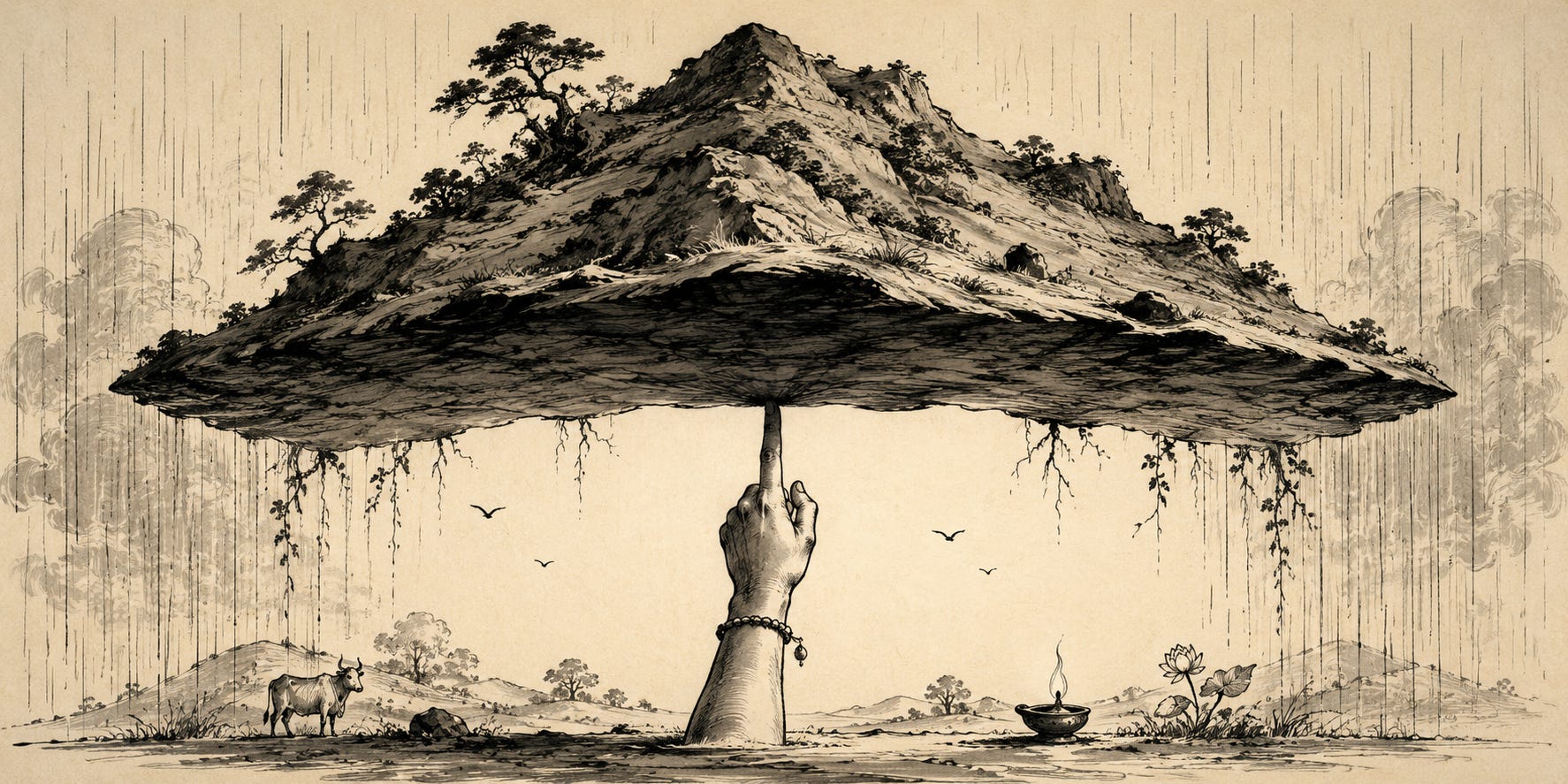
The old woman told it when the rain had made the courtyard shine.
All evening the eaves had dripped. The stone step was cold under the child’s bare heels, and the lamp-smoke smelled of oil and blackened cotton. Beyond the door, frogs called from the wet grass. The grandmother drew the child nearer with one dry hand.
“Listen,” she said. “This is a tale for rain.”
The child looked at the lamp.
The flame bent once, as if it too had heard.
—
In the cowherd village at the foot of Govardhana, the rains had always been honoured.
When the season turned, the women washed the stones. The men brought milk, curds, grain, butter, and garlands. The children ran behind them with wet feet and bright mouths. The calves wore little strings around their necks. The bulls shook their horns and rang their bells.
Above them stood the mountain.
It was not the highest mountain in the world. It did not tear the sky. It did not wear snow. It rose green and broad above the grazing land, with caves in its sides, peacocks in its groves, herbs on its slopes, and springs that tasted of stone.
The people loved it without saying so.
They leaned on it with their eyes.
That year, as the offerings were being prepared, Krishna came among them.
He was still young enough for the mothers to look for mud on his knees. His hair was dark from the rain. A peacock feather clung to him as if it had chosen him. Around his wrist was a little coil-scale charm one of the boys had found near the stream, smooth as a fingernail and dark as wet seed.
He watched the men stack pots of butter.
He watched the women tie lotus buds with thread.
He watched the old priest measure the ground with a cord before placing the fire-stones.
“Why are these things gathered?” Krishna asked.
The old priest smiled, because everyone smiled when Krishna asked a question.
“For the lord of rain,” he said.
Krishna looked up.
Clouds moved like dark cattle across the sky.
“And who feeds our cows?” he asked.
“The grass,” said one boy.
“And who feeds the grass?”
“The rain,” said another.
“And where does the rain rest when it has fallen?”
No one answered at once.
Krishna touched the wet earth with his toes.
“It rests here,” he said. “On Govardhana. In the grass. In the leaves. In the streams. In the hollow where the calf drinks. In the field where the grain bends. Why send our thanks so far away that they forget the path home?”
The priest lowered the measuring cord.
A pot of curds slipped in a woman’s hands, but she caught it against her hip.
Nanda, Krishna’s father, stood under the edge of the cattle shed. Rain ticked from the thatch beside his shoulder.
“Child,” he said gently, “these are old ways.”
Krishna turned to him.
“Then let them be old enough to be true.”
No one laughed.
The rain on the leaves grew louder.
Krishna walked to the offerings and lifted a bowl of fresh butter. His fingers shone. He held it toward the mountain.
“Feed the cows,” he said. “Feed the hill. Feed the people who work in the rain. Let the milk return to the calves and children. Let the grain return to the hands that grew it. Let Govardhana be honoured today.”
The old priest looked at Nanda.
Nanda looked at the villagers.
The village held its breath as a herd does before thunder.
Then a cow lowed from the shed.
A little girl laughed.
Someone said, “Bring the leaf-plates.”
And the old way turned, not like a door thrown open, but like a lamp lifted from one room into another.
They carried the offerings around Govardhana.
They sang to the slopes. They gave rice to the herdsmen. They placed butter near the stones. They set curds by the roots. Children fed handfuls of grass to the calves. Women poured milk into bowls and set them on flat rocks where rainwater trembled at the rim.
The mountain received everything.
Its grasses shivered. Its caves breathed cool air. Its peacocks cried from the green dark.
Krishna walked before them, smiling.
Some said they saw the hill smile back.
That evening, the rain softened.
The village ate beneath the eaves. The cows slept with full bellies. Children fell asleep smelling of curds, wet grass, and smoke. On the mountain, the last bowls of milk stood pale in the dusk, and no thunder answered.
By morning, the people had begun to hope that the sky had understood.
—
Far above the fields, where lightning sleeps before it is loosed, the lord of rain heard that his worship had been turned aside.
His cup stood full.
His white elephant stamped.
Clouds gathered at his doors like servants waiting for anger.
He looked down and saw the village resting beneath its thatch. He saw milk pale on stone. He saw children waking warm. He saw Krishna walking barefoot in the wet grass, with butter still bright on his hand.
His face darkened.
“Let them learn who fills their roofs,” he said.
The clouds bowed.
“Let them learn who breaks them.”
Then the sky changed.
At first the village thought it was only a heavy rain.
The women drew shawls over their heads. Men drove the calves into shelter. Children shouted and ran. The paths became shining threads. The dust became red paste underfoot.
Then the rain thickened.
It came slantwise.
It struck the leaves flat.
It beat the river until the river forgot its banks. It filled the hoof-marks. It burst the small dams. It drove into the cattle sheds and rattled the pots against the walls.
The wind came after it.
Doors shook, and thatch lifted at the corners. The lamps went out one by one.
A boy tried to carry a newborn calf and fell in the mud. His father hauled him up by the back of his tunic. An old woman slipped on the stone path and clutched at a post. The post came loose in her hand. A cow bellowed from the dark, and the sound went through the village like a horn made of fear.
By midnight the fields were water.
By dawn the paths were gone.
The mountain itself was veiled.
Nanda stood in the storm with rain pouring from his beard.
“This is no rain for crops,” he said.
A woman pressed her baby under her shawl. The child’s small hand beat against her throat.
The old priest held the soaked measuring cord. It hung useless from his fist.
“Call the boy,” someone said.
Krishna was already there.
He stood where the path to Govardhana began. The rain ran down his face. His feet were sunk in mud. His coil-scale charm clung dark against his wrist.
The villagers came to him with water at their ankles.
Their baskets were floating away. Their grain was spoiled. Their cattle were crying from the sheds. Their cooking fires were ash and smoke.
“Krishna,” Nanda said.
The boy looked at him.
The father had no words after that.
The sky cracked.
For one white breath, everyone saw the mountain.
Then the darkness closed again.
Krishna turned toward Govardhana.
He placed one hand on the wet stone at its foot.
The hill was slick beneath his palm. Grass flattened against his fingers. Mud pressed between his toes. Rain struck his shoulders so hard that the children hid their faces.
He smiled.
It was not a large smile.
It was the kind of smile a mother gives before lifting a sleeping child.
Then Krishna bent and placed the little finger of his left hand beneath the mountain.
The earth trembled.
Roots tightened.
Snakes slid deeper into their holes. Birds burst upward from the trees and vanished into rain. The cows stopped crying.
Govardhana rose.
Not with thunder.
Not with tearing.
It rose as a mat rises when a hand slips beneath it.
Water poured from its slopes in silver ropes. Trees shook themselves free of earth. Caves opened like dark mouths. Stones groaned, then settled. Beneath the lifted mountain, a wide dry hollow appeared, shadowed and green, with earth still warm where the hill had rested.
Krishna stood beneath it with his arm raised.
The mountain balanced on his finger.
He looked back at the village.
“Stay beneath my hand. Do not run.”
For a moment no one moved. Rain struck the empty place where the hill had been and leapt like thrown glass. A calf took one step toward Krishna and then another. The little bell at its neck gave one clear sound.
Then the village broke toward him.
—
They came under the mountain with bundles, babies, grain pots, ropes, churns, blankets, dogs, goats, and all the trembling cows.
Men pushed carts through mud that sucked at the wheels. Women carried lamps cupped inside their shawls. Children clung to tails, sleeves, waist-cloths, anything they could catch. One old man crawled the last few steps on his knees because the water had taken his sandals and the cold had entered his bones.
Nanda reached for Krishna’s raised arm.
“Son,” he whispered.
Krishna did not lower it.
“I am not tired,” he said.
His voice was small enough for a child.
It was large enough for the mountain.
The villagers crowded beneath Govardhana. They stood where roots hung from the lifted earth like sleeping serpents. Water streamed beyond the edge in a shining wall. Outside, the world was storm. Inside, the cows breathed warmth into the hollow. Milk steamed in bowls. Lamps were lit again, one from another, until little flames trembled under stone.
In the room where the tale was being told, the grandmother reached out and trimmed the lamp-wick with her fingers.
The flame steadied.
In the tale, the people looked at Krishna.
He stood smiling under the mountain.
His arm did not shake.
The first day passed.
Children were hungry. Mothers fed them from what had been saved. The old priest laid the wet measuring cord beside a lamp to dry. The cord steamed faintly, curling like a small sleeping snake.
Outside, the rain fell harder.
The second day passed.
Men tried to count the cattle and failed because the calves kept pushing toward Krishna. One calf licked his ankle. Another slept against his foot. Krishna laughed softly, and the sound ran through the hollow like warm milk poured into a brass cup.
The third day passed.
No one spoke of leaving.
The fourth day passed.
A woman whose house had broken under the rain sat with both hands around an empty grain jar. She did not weep loudly. She only pressed her forehead to the rim and rocked. Krishna looked at her, and one of the boys brought her a bowl of curds without being told.
The fifth day passed.
The storm outside grew angry that it could not enter.
Lightning struck beyond the mountain’s edge. Thunder rolled under the lifted roots. Rainwater ran like rivers all around them, but inside the hollow the lamps held.
The sixth day passed.
Krishna did not shake. But once his mother saw a pale line where rain had dried along his lifted wrist. She looked at it, then looked away, and held the end of her shawl between both hands.
Doubt came quietly.
It did not shout like thunder. It moved from shoulder to shoulder. It entered the knees of tired men. It entered the wrists of women holding sleeping children. It entered the old priest as he watched the boy’s raised hand.
What if the arm fell?
What if the mountain slipped?
What if the hill remembered its weight?
A boy saw the fear and began to cry.
Krishna turned his head.
“Come here,” he said.
The boy came, wiping his nose with the back of his hand.
“Put your stick beside mine,” Krishna said.
The boy stared.
“I have no stick.”
“Then use your finger.”
The boy lifted one finger and pressed it upward toward the mountain from far below. Another child did the same. Then another. Soon every child under Govardhana stood with one arm raised, holding nothing, helping everything.
The old priest laughed then.
It surprised him so much that he dropped the measuring cord.
The people laughed too, softly at first, then with tears running down their faces.
Krishna stood among them with the mountain on his hand.
Above the storm, the lord of rain watched.
His anger had emptied its jars. His clouds had spent themselves. His thunder had grown hoarse. Still the village lived under the lifted hill. Still the cows breathed. Still the lamps burned. Still the child stood smiling.
The white elephant lowered its head.
The lord of rain looked down at the boy beneath Govardhana.
He saw no fear there.
He saw no boasting.
He saw a hand held up so others could shelter.
The rain weakened.
It became rain again.
It fell straight, then soft, then sparse, until the earth could hear itself again.
—
On the seventh day, the first clear light came under the edge of the mountain.
No one trusted it.
They listened.
There was no thunder.
They smelled the earth.
It smelled torn, wet, living.
A cow stepped toward the open air, then stopped and looked back, as if asking permission.
Krishna nodded.
The people began to leave.
Their legs cramped from standing. Their eyes stung in the sudden light. Mud took hold of their ankles. One child slipped and came up brown to the elbows. An old woman’s knees shook so badly that two girls held her between them. The fields were flattened. The walls were broken. The cooking fires were black ash.
But the sky was open.
Govardhana still rested on Krishna’s finger.
When the last calf had passed out, when the last lamp had been carried into the pale morning, when Nanda stood with the old priest and all the villagers beyond the mountain’s shadow, Krishna lowered his hand.
Govardhana returned to the earth.
It settled gently.
Not a hut shook.
Not a bird fell.
Not a root tore.
The mountain stood where it had always stood, but no one saw it as they had seen it before.
The people came toward Krishna.
No one knew whether to laugh or weep or scold him for standing so long in the cold. His mother reached him first. She seized his arm and rubbed it hard between her hands, as if warmth could be forced back into a god by a mother’s worry.
“Does it hurt?” she said.
Krishna looked at his little finger.
A trace of wet stone lay across it like ash.
“No,” he said.
Then, after a moment, he added, “Perhaps a little.”
His mother pulled him into her shawl.
The village exhaled.
The old priest picked up the measuring cord from the mud. It had dried crooked during the days under the hill. He wound it slowly around his hand, then unwound it, then laughed again.
“What shall we measure now?” someone asked him.
The old priest looked at the mountain.
He looked at the boy.
He placed the cord at Krishna’s feet.
“No farther than this,” he said.
The children gathered fallen lotus buds from the ruined offering baskets. They laid them on stones. The cows grazed where the water had begun to run away. Women scraped ash from the dead hearths and built new fires. Men lifted broken beams and set posts again. The village did not become rich. The roofs did not mend themselves. The grain did not leap back into the jars.
But they were alive.
That evening, when the first cooking smoke rose, everyone looked at Govardhana.
The mountain darkened in the setting light.
Peacocks called from its slopes.
Somewhere high above, the last cloud passed without anger.
—
The grandmother stopped.
The rain outside had softened. The courtyard still shone, but the drops from the eaves were slower now. The child sat very still beside the lamp.
“Did the mountain feel heavy?” the child asked.
The old woman smiled and drew the shawl around them both.
“For whom?” she said.
The child thought about this.
The lamp flame leaned toward the doorway. On the cold stone step, rainwater held a small yellow light, and the night smelled of oil.