

The Kindness That Continues
On everyday altruism, altered evidence, and the small acts that keep justice human.

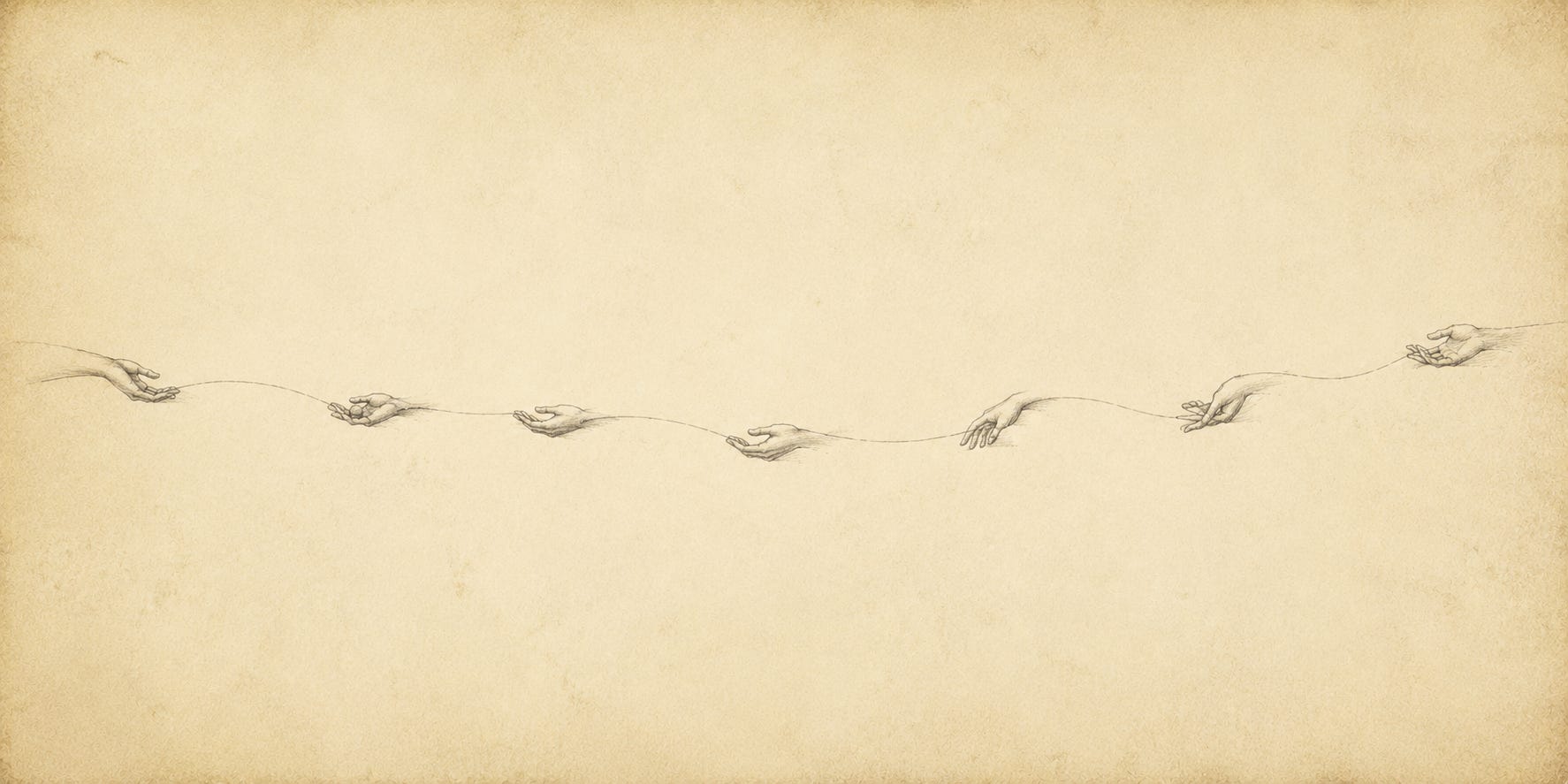
One act of kindness is never enough.
That is the first thing to admit, because without that admission kindness becomes dishonest. It becomes one more way for a society to admire private virtue while leaving public failure intact. A hungry person should not have to depend on the moral mood of strangers. An unhoused person should not have to wait for generosity to become visible in a passer-by. A sick person should not have to become fortunate before receiving care.
When a society asks kindness to do the work of justice, it is not honouring kindness.
It is exploiting it.
But the opposite error is just as dangerous. Because kindness is not enough, we are tempted to decide that it is not much. Because it cannot carry the whole weight of the world, we begin to treat it as ornamental. Because it cannot replace law, housing, medicine, safety, wages, and institutions, we imagine it belongs to the soft margins of life, suitable for children’s stories, private sentiment, religious consolation, or seasonal speeches.
This is a mistake.
Kindness is not a substitute for structure. It is one of the forces that teaches structure how to remain human.
The act itself may look almost weightless. Someone lifts what another person cannot carry. Someone pays a fare for a stranger whose card has failed. Someone waits beside a frightened person until help comes. Someone puts food down without making the hunger perform gratitude. Someone absorbs a moment of inconvenience without turning it into a grievance. Someone sees humiliation approaching another human being and quietly steps between.
Nothing large appears to have happened.
The traffic continues. The queue moves. The office door closes. The bus pulls away. The person helped may never know the helper’s name. The helper may forget the act by evening. No system has changed. No injustice has been abolished. No headline records it.
And yet the moral temperature of the next moment is different.
This is the difficulty with small kindness. It almost always looks too small for the world it enters. Against hunger, war, loneliness, bureaucracy, poverty, displacement, illness, fear, and the great organised brutalities of human life, an ordinary act of mercy can appear absurd. What is one lifted bag against the machinery of despair? What is one meal against famine? What is one patient sentence against generations of contempt? What is one gentle hand on the arm against all the systems that have taught people to flinch?
The objection is not foolish.
There are forms of suffering that cannot be repaired by private goodness. There are wounds too deep for amateur mercy, injustices that require law rather than patience, protection rather than niceness, distance rather than access. A mature ethic of kindness must know this. It must not romanticise burnout, self-erasure, or the endless availability of the good-hearted. It must not ask exhausted people to keep giving because the world has refused to become just.
Kindness is not the abolition of judgement.
It is the refusal to let judgement become an excuse for contempt.
Every system, however just in design, must eventually pass through a person. The law passes through the officer. The clinic passes through the receptionist. The school passes through the teacher. The shelter passes through the person at the desk. The policy passes through the voice that explains it, the eyes that meet or avoid, the hand that stamps a document, the tone that either preserves dignity or takes one last coin from it.
A system can open a door.
A person can still make another human being crawl through it.
That is why the small act matters. It is not small because it happens between two people. Between two people is where the world is repeatedly made real.
Human beings are transmissive creatures. We catch more from one another than illness. We catch fear, contempt, suspicion, courage, impatience, steadiness, cruelty, gentleness. A room can learn panic from one face. A crowd can learn permission from one insult. A child can learn shame from one laugh that should not have been allowed to stand. We know this when the contagion is dark. We know how quickly harshness travels. We know how a workplace becomes cold, how a family learns silence, how a public conversation becomes cruel, how one person’s defendedness teaches another person to defend first.
But goodness travels too.
A person who receives unrequired kindness is not merely helped. For one moment, the evidence of the world changes. The world had seemed to say: you are alone; you are in the way; your need is embarrassing; no one will stop unless paid, praised, compelled, or watched. Then someone stops. Not because the person has earned it. Not because the exchange is clean. Not because repayment is likely. Someone stops because another human being is there.
That moment may not last. It may not produce anything measurable. The receiver may be too tired, frightened, ashamed, angry, or wounded to feel grateful. The helper may receive no warmth in return. Kindness is not always rewarded by visible transformation. Sometimes it falls into silence. Sometimes it is misunderstood. Sometimes it is taken and forgotten. Sometimes the person helped remains difficult. Sometimes the giver becomes tired.
But measurement is not the same as consequence.
Some acts remain alive after their visibility ends. A person helped without humiliation may later help without humiliating. A person who witnessed courage may find it easier, later, not to join cruelty. A child who saw an adult refuse contempt may discover, years afterwards, that the refusal had entered their own conscience. Someone treated gently at the exact moment when they expected dismissal may carry that contradiction into the next hour, the next conversation, the next chance to harden.
This is how kindness continues: not always as gratitude, and not always as imitation, but as altered evidence.
It gives the soul one more example against despair.
The deepest acts of kindness often refuse display. They are careful not to turn another person’s need into the giver’s identity. They know that mercy can humiliate when it enjoys being seen. The most exact kindness does not say, Look how generous I am. It says, Let this be easier for you. It tries to leave the receiver more whole, not more indebted.
This matters because help can wound. A gift can place the giver above and the receiver below. A favour can become a theatre of superiority. Charity can ask suffering to become photogenic. Even kindness, when corrupted by vanity, can make the vulnerable pay for assistance with exposure.
The kindness that continues is usually quieter than that.
It protects the other person’s face.
Here the face matters. Not the face as appearance, but as the place where abstraction ends. It is easy to love humanity at a distance. It is easy to believe in justice when no particular person interrupts the afternoon. It is easy to speak of compassion while remaining untouched by the inconvenient, the repetitive, the awkward, the slow, the frightened, the ungrateful, the one who arrives at the wrong time with the wrong kind of need.
Then there is a face.
A real face disorganises theory. It asks for something before we have finished deciding what kind of person we are. It does not permit us the comfort of loving mankind while ignoring the man in front of us. The face says: here, not later. This person, not the idea of persons. This need, not the concept of need.
That demand can become unbearable. No one can answer every face. No one can carry infinite responsibility without breaking. There are people who will consume whatever is given and call the giver selfish when they finally stop. There are needs too large for one person, wounds too deep for one pair of hands, griefs that require a community, harms that require protection, crises that require institutions.
This is why everyday altruism must be defended on both sides. It must be defended against the cynic who says it is too small to matter. It must also be defended against the sentimentalist who asks it to replace the work of justice. The cynic cannot see the current because it is not always measurable. The sentimentalist romanticises the current until exhausted people are made responsible for holding back the sea.
The truth is more exact.
The small act does not become powerful by pretending to be large. It becomes powerful by being faithful to its scale. It changes the next encounter. It lowers the next threshold. It gives the next person one less reason to believe that hardness is the only intelligent response to the world.
A society is not transformed only by great laws, revolutions, reforms, courts, movements, institutions, and public victories. It is also transformed by the countless unrecorded moments in which people teach one another what may still be expected from a human being. The law may forbid cruelty, but it cannot by itself create tenderness. The state may provide a room, but it cannot guarantee welcome. A policy may deliver food, but the hand that gives it can still either preserve dignity or take it away.
Justice must become architecture.
But architecture must pass through persons.
A society that does not turn away must build roads, shelters, systems, and durable forms of mercy. But those roads are walked by people. Those shelters are entered through human voices. Those systems are inhabited by faces, hands, tones, pauses, small decisions. The macrostructure of mercy depends on the microclimate of encounter.
A cold person can make a humane institution feel cruel.
A kind person can make an insufficient institution feel, for a moment, less abandoned by the world.
Neither fact cancels the other. The institution must still be repaired. The hungry must still be fed by more than accident. The lonely still need more than a stranger’s brief attention. But without human warmth, even a necessary system can become only a corridor. It may move bodies from one place to another. It may process need. It may reduce harm. Yet something essential is missing if no one, inside that structure, knows how to recognise the person before them.
The kindness that continues is not always dramatic. It may be a sentence. A refusal to mock. A minute of patience. A door held without irritation. A correction made without cruelty. A debt forgiven quietly. A child defended. A stranger believed. A tired worker thanked as though they were visible. A person in grief not hurried back into usefulness. A mistake answered without humiliation. A place made at a table.
These things sound small because language is poor at weighing atmosphere.
But everyone knows the difference between a room where need is punished and a room where need is allowed to exist. Everyone knows the difference between assistance that reduces the body while helping it, and assistance that leaves the person standing. Everyone knows how a single human act can enter a day and change the shape of it, not by solving everything, but by preventing the final inward conclusion: no one cares; everyone is defending themselves; I would be a fool to remain open.
Kindness interrupts that conclusion.
It says, not always in words: do not close yet.
That may be its deepest social power. Not that one act fixes the world. Not that generosity always multiplies. Not that goodness, once offered, becomes inevitable. Nothing human is inevitable. But one act can prevent a person from fully surrendering to the evidence of cruelty. It can delay the hardening. It can make a witness ashamed of their indifference in the fruitful way shame sometimes works: not as self-hatred, but as recall. It can give the giver a memory of having acted from somewhere cleaner than fear.
And sometimes, later, another hand moves.
The movement may be untraceable. The original act may be gone from memory. A kindness received in childhood may become patience with a stranger thirty years later. A meal given without condescension may become a refusal to humiliate someone else in need. A moment of being defended may become courage in a room where another person is being made small. A mercy witnessed may return long after the witness thought it had been forgotten.
At the end, the act may still look small.
The bag lifted. The fare paid. The food placed down. The insult not joined. The frightened person not left alone. The face protected. The hand extended and then withdrawn before it could become theatre.
Nothing large appears to have happened.
But somewhere the next encounter has become slightly less impossible.
Someone has been given one more reason not to harden.
And sometimes that is how a society begins again: not when kindness saves the world, but when it passes through one person into the next, quietly rebuilding the trust on which every better world must stand.
Among the many things I admire about Varro is his absolute startling ability to articulate the ‘invisible’ notions that we instinctively feel but rarely have the ability to articulate. He dismantles the obvious and mundane only to reveal a profound and powerful truth.
This essay does many of us a salutory service. Often, I am sure, we find ourselves offering a sense of powerlessness in the face of scale. What is the point, we might say? Poverty is so great what can I small person like me do? We dismiss charitable opportunities because the challenge is beyond us. Now we can be comfortable with selfishness.
Lucas Varro gives us the answer.
“And sometimes that is how a society begins again: not when kindness saves the world, but when it passes through one person into the next, quietly rebuilding the trust on which every better world must stand.” (Varro)
Let’s get up and do!