

Fires of the Old World VII — The First Arrow
A boy enters the forest, and righteousness takes its first blood-price.

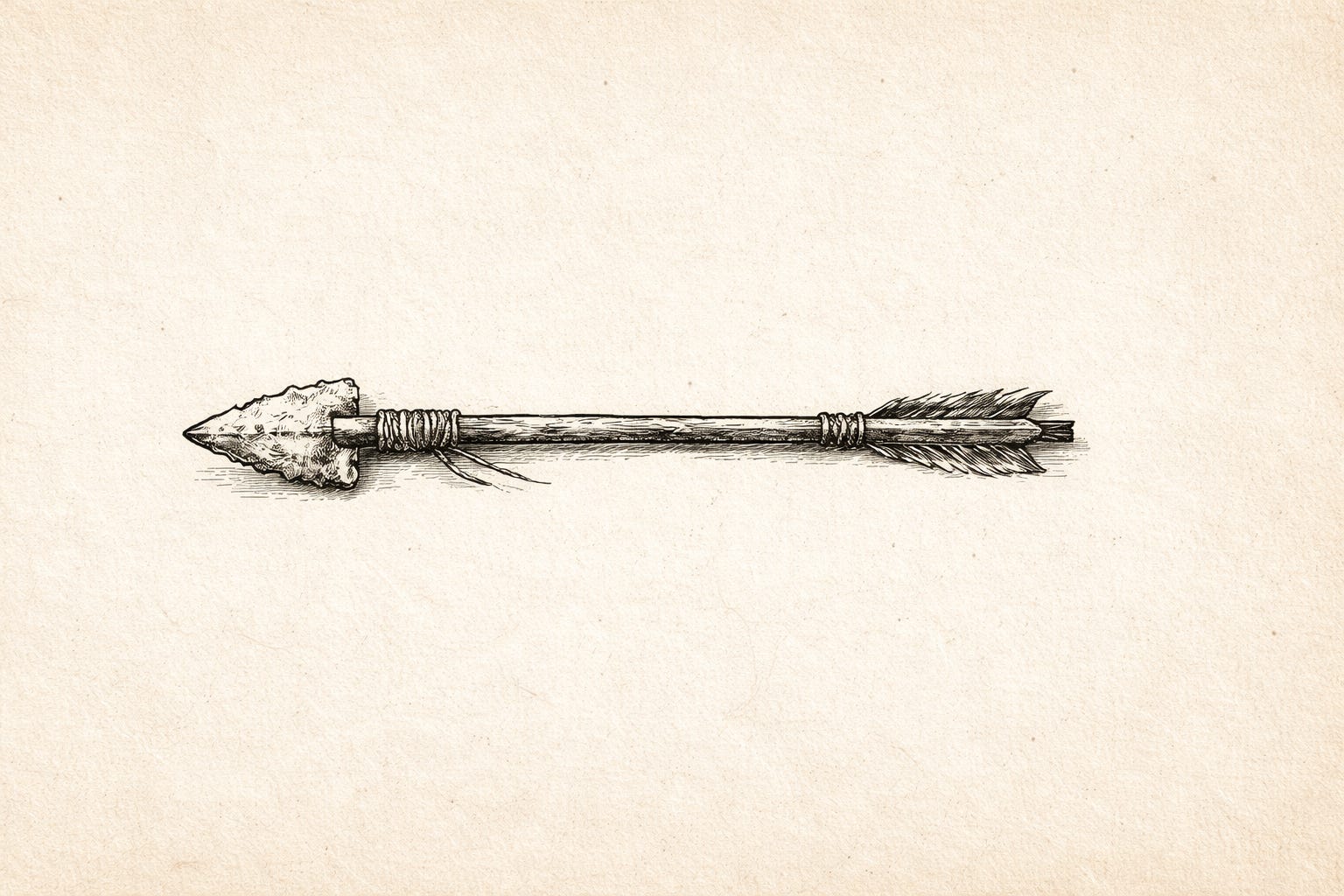
By a low lamp, an old woman tells of the first true crossing: the hour when a prince was asked not merely to aim well, but to live with what the arrow would do.
The children had drawn close before the tale began, their heels on the warm reed mat, the lamp making small moons on their knees. Outside, night insects stitched at the dark. Inside, sesame oil breathed from the clay dish. Hearth-smoke lay under the rafters, and the cool evening air had come in through the bamboo slats and settled around their ankles. The old woman turned the wick with a wetted finger. The flame bent, then stood, and made a little gold path across the floor.
“Listen,” she said. “This was before kings grew heavy with crowns. This was when a bow could still fit a boy’s hand, and the forest knew his scent.”
She had a measuring cord beside her, coiled like a resting snake. One child touched it and drew his hand back.
“In those days,” she said, “there was a prince who still slept like a child, one arm above his head, the mark of the pillow still on his cheek when he rose. His name was Rama.”
—
The sage came at dawn.
The palace had not yet grown loud. Dew lay on the stone steps. In the eastern basin a lotus had just opened. Rama was in the yard with his brother Lakshmana, their fingers sore from the bowstring, when the guards lowered their spears and let the forest-man pass.
He was old, but not frail. Bark cloth hung from his shoulders. Ash lay on his skin. It did not make him look lesser. It made him look as though fire had once tried to keep him and failed. His hair was matted. His eyes were bright under his brow. When he stood before the king, even the hanging banners seemed to grow still.
He did not ask for gold. He did not ask for land. He asked for the boy.
The court shifted. The king’s hand tightened on the lion arm of his chair.
“My son is young,” he said.
The sage looked at Rama, not at the king. “So is the moon when it first rises.”
There were rites to be kept in the deep forest, he said. Fires to be fed. Offerings to be laid down with clean hands. But the rites had been broken again and again by one who haunted that place, a woman in shape and a storm in hunger. Tataka. Her name moved through the hall like cold air under a door.
Some men lowered their eyes.
The king offered soldiers. Chariots. Hunters with seasoned hands. The sage refused them all.
“I need the hand that has not yet learned to shake after the deed,” he said.
The words struck Rama like cold water. He had hunted deer in the royal preserves. He had split reeds at thirty paces. He had loosed shafts into straw men until the straw showed daylight. But this was no deer. No lesson. No bright morning with servants waiting nearby and sweet water in the shade.
This was a forest with a name inside it.
His father’s face had changed. That hurt him more than the request. The king who had once lifted him laughing onto an elephant’s neck now looked at him as though he stood already far away.
Then the sage spoke the bargain plainly, so no one in that hall could pretend not to hear.
“Let him come,” he said, “and the rites will stand. Refuse, and the forest will keep its own law. Give me the boy, and I will return you a man.”
The hall fell quiet enough for the oil flames to be heard.
Rama bowed, because his father had not yet found breath to answer. When he straightened, Lakshmana was already beside him.
“Where he goes,” Lakshmana said, “I go.”
The sage gave one small nod, as though this too had been counted.
—
They left before the heat came up from the road.
No drums marked their going. No conch sent them out through the gate. Rama had thought there might be some brightness in departure, something large enough to carry him forward. Instead there was dust, a water skin against his shoulder, the rub of fresh leather at his wrist, and his father’s hand resting for one moment at the back of his head.
It did not bless him. It lingered.
His mother put a small lamp into his hands, no bigger than two joined palms. “For the first night,” she said.
Lakshmana smiled. “We are not girls in a wedding train.”
But Rama took it. The clay was warm from her touch. He wrapped it in cloth and tied it to his pack. Later he would remember that weight more clearly than the weight of the bow.
The city thinned behind them. Walls gave way to fields, fields to scrub, scrub to the first dark breathing of trees. The sage walked as though there were a road beneath the ground and he alone could feel it. At a ford he gave them water from the hollow of a leaf and taught them a mantra, not for triumph but for steadiness: to cool hunger, lengthen breath, and make the eye clear without hardening the heart.
By the second day the forest had changed its face.
There were broken trunks silvered by old lightning. Mud where no stream ran. Bones under creepers. A smell of rot that came and went though the air was still. Once Rama heard a branch crack somewhere ahead, and all three of them stopped, but nothing came. Flies crawled on a strip of hide caught in thorns. The path narrowed. A thorn vine scored his calf through the cloth. He laid his hand on the bark of a sal tree and felt a faint trembling in it, as though some old fear still moved under the wood.
“This was once a blessed place,” said the sage.
“Who broke it?” Lakshmana asked.
The sage stooped and lifted something from the leaf mould. An arrowhead, old but clean, as though the forest had kept rust from it. He placed it in Rama’s palm.
“Men have passed this way before you,” he said.
The metal was colder than it should have been. Rama tucked it into the fold of his sash.
At dusk they came to the hermitage grounds: trampled altars, scattered kusa grass, a prayer post split in two. Ash lay in shallow drifts where sacred fires had been stamped out. Rama knelt and touched it. It was fine as sifted flour. It clung to the lines of his fingers.
The sage stood above the broken ground. His face held no anger now. Only tiredness.
“This is the threshold,” he said. “Keep watch here, and the world will not be as it was.”
Rama looked at the ash on his hand, the broken altar, the trees leaning in.
“Must it be me?”
“It must be the one who can still ask.”
Night came quickly. No stars showed through the canopy. Lakshmana kept close, arrow nocked, all quick breath and listening. Rama unwrapped the little clay lamp and lit it from the hermits’ one surviving ember. Its flame made only a small ring, but inside that ring the ground became plain again: the mat, the post, the rise and fall of his brother’s chest.
Far off, something laughed.
Not like a woman. Not like an animal. Like a branch breaking in a burnt house.
Rama’s hand moved to the arrowhead in his sash.
—
Morning did not brighten the forest. It only thinned the dark.
The rites began. The sage stood before the rekindled fire and poured clarified butter into the flame. The smell was sweet, almost homely. It did not belong there. Perhaps that was why it mattered.
Rama and Lakshmana kept the edge of the clearing.
The first assault came as sound. Shrieks with no throat behind them. Monkeys burst from the trees and vanished. Branches bowed though nothing crossed them. Lakshmana loosed at movement and struck only leaves.
The second came as filth. Red mire fell from above, spattering altar and ground though the sky showed clear in the gaps of the canopy. Rama smelled carrion, sour milk, and the iron stink of old killing. He heard the fire hiss under the foulness. The sage did not stop chanting.
“Show yourself,” Lakshmana shouted.
A voice answered from behind them, then above, then near Rama’s own ear.
“Little princes,” it said. “Do they send cradle boys now?”
Rama turned. Nothing. Only trunks, vines, and a torn curtain of creeper moving against the wind.
Then he saw her.
First a hand on a tree trunk, long-nailed and strong enough to sink the bark. Then a shoulder broad as a gatepost. Then the face, if face it could still be called: a woman’s shape kept by fury, hair hanging in dark coils, tusk-broken teeth showing in a wet mouth, one ear torn away, and eyes yellow as old resin in shadow. She smiled too wide.
Tataka.
The clearing seemed to narrow around Rama’s ribs. Every teaching he had ever been given rose up at once and tangled in his chest. Woman. Rakshasi. Devourer. Body. Name. None of the words held her.
The sage’s voice came from the altar fire, steady as if he were speaking over the evening meal.
“Do not wait for the shape to soften your hand. Loose for what stands before you.”
Tataka laughed and tore up a young tree by the roots. She hurled it. Rama sprang aside; bark ripped his shoulder as it passed. Lakshmana’s arrow struck her arm. She snarled, and dead leaves shook down from the branches.
Rama drew, but the string held him. He had been taught against cruelty. Taught to honour women. Taught that strength without measure shamed the hand that wielded it. All that teaching stood up in him now and would not move.
Tataka saw.
Her grin changed.
“Ah,” she said softly. “There you are.”
She moved so fast the eye came after her. One instant she was at the trees, the next she was through them, all weight and hunger and rank breath. Rama stumbled back. Mud took his heel. The world tilted.
Then Tataka’s hand closed around the prayer post and snapped it like dry cane. Splinters flew across the altar ground. The little lamp beside the fire toppled and shattered. Oil flared once and died in the ash.
Something in Rama answered that sound.
Not anger. Not glory. Only this: if he withheld the arrow, the breaking would go on.
He set his feet. Felt the mud hold him. Felt the torn bark burning on his shoulder. Felt the old arrowhead cold at his waist. He drew until the bow was one curved breath in his hands.
Tataka came through smoke and leaf-shadow, huge, grieving, terrible.
He loosed.
The shaft crossed the clearing with no splendour to it. No thunder. Only the clean sound of a thing sent true.
It struck below her collarbone.
She stopped.
The forest stopped with her.
For a moment she looked almost puzzled, as though she had forgotten that any hand could answer her. Then the force went out of her limbs. She took one step, then another, and sank to her knees. When she struck the ground, the earth answered dully, like a door shut on an empty room.
The silence after was worse than the cry had been. No bird called. No branch stirred. Rama’s hands were still lifted in the shape of the shot.
Tataka lay breathing.
He had not thought of that. In practice, the arrow struck straw and the lesson moved on. Here the arrow entered flesh, and life did not leave at once. Her blood was dark, but not much of it showed. What showed instead was effort: the hard work of breath, the body still trying to remain.
Rama went to her before he knew he had moved.
Her eyes found him. In them there was no storm now. Only weariness. And something older than rage.
Her hand opened once against the leaves.
Then it did not move again.
A wind passed through the clearing and took the carrion stink with it. Somewhere high above, unseen birds began again, one call, then another.
Rama looked down at his own fingers. They were shaking.
The sage came and stood beside him. He did not praise. He did not comfort. He planted his staff in the broken ground and let the boy breathe.
Lakshmana touched Rama’s hand, very briefly.
The altar fire, somehow, had not gone out.
—
They left the clearing before nightfall.
The hermits would cleanse the place. The sage would finish the rites. There was no need to remain where the price had already been paid.
The way back through the trees was shorter, yet harder. Rama’s legs cramped on the narrow rise above the ford, and once his foot slipped on a wet root. He caught himself with his palm against a stone and came away with skin torn open and grit in the cut. He said nothing. The sting was small beside what he carried.
At the water’s edge he knelt to wash his hand. The stream ran brown a moment, then clear. As he bent, something slid from his sash and struck the rock.
The old arrowhead.
He picked it up and turned it once in the dim light. Then he set it on the bank among the reeds and left it there.
That night, when they camped beyond the worst of the forest, Lakshmana slept at once, one hand still near his bow. The sage sat wakeful. Rama unwrapped the cloth bundle from his pack and found the little lamp broken after all, split along one side where the fall had found it.
He held the pieces in his lap.
The sage looked up. “Some things do not cross the threshold whole.”
Rama ran his thumb along the cracked clay. “It was a small thing.”
“Yes.”
But he knew then that small things were often where the cost chose to show itself.
—
By the time the old woman reached this part, the youngest child had leaned against her knee. The lamp between them had burned lower. Oil gathered thick at the rim. A moth circled once and vanished into the dark above.
“What happened when he went home?” the smallest one asked.
The old woman lifted the measuring cord and let it uncoil across the mat. In the wavering light it looked for a moment like a pale line laid on water.
“He went home taller in no way the eye could count,” she said. “His mother saw it first. His father heard it in his tread. His brother knew it when Rama woke and did not reach at once for the things of childhood.”
She wound the cord back into her palm.
“Did he become hard?”
The old woman looked at the low flame.
“No,” she said. “Only older.”
The children were quiet. Outside, the insects went on sewing the night together. The room smelled of oil, ash, and cooling rice. One child reached towards the lamp as if to steady it, then stopped, seeing how near the wick was to spent.
The old woman bent and pinched the flame out between damp fingers.
For a breath the dark stayed warm.
Then only smoke.
And so the tale leaves us where many old tales do: not with triumph, but with the quiet shape of its cost. The lamp burns low. The room grows still. Something has been left behind, and something older has begun.