

Fires of the Old World XIV — The Fallen Trees
A hearth-tale of Krishna, the mortar, and the two trees that waited

Listen close.
Outside the cowherd village, where the night smelled of warm milk, damp grass, and lamp-oil, two great trees stood with their roots deep in the dark. Their leaves whispered even when there was no wind. Their bark was old, grey, and split like tired hands.
A child by the hearth leaned against his grandmother’s knee.
“Were they alive?” he asked.
The old woman turned the wick of the lamp lower.
“All trees are alive,” she said. “But these two were waiting.”
—
In those days, Krishna lived among the cowherds of Vrindavan, in the house of Nanda and Yashoda.
He was still small enough to crawl beneath the benches. Small enough to steal butter with both hands and leave white prints along the wall. Small enough to be caught with curds on his mouth and laughter in his eyes.
But nothing in that house stayed where it had been left.
Pots were emptied. Calves were untied. Butter vanished from high shelves. The milkmaids would come to Yashoda with their bangles clinking and their voices sharp with complaint, though each one softened when the child looked up.
“He has taken from my churn.”
“He has fed the monkeys.”
“He has broken the hanging pot.”
“He smiles when we scold him.”
Yashoda would lift him into her lap. She would wipe his mouth. She would look into his dark face and try to be stern.
Krishna would blink.
The bangles would fall silent.
Yet a mother has work to do, even when gods hide in the house as children.
At the edge of Nanda’s yard stood two Arjuna trees.
They were taller than the houses. Taller than the cattle-sheds. Their crowns held birds in the morning light, and their trunks stood close together, with only a narrow space between them.
Children played beneath them.
Cattle rubbed against them and moved on.
Beneath that bark, two names had not finished waiting.
Nalakubara.
Manigriva.
Once, those names had moved through bright courts with gold at their wrists, wine on their breath, and garlands slipping from their hair. Once, the sons of Kubera had laughed beside clear water as though no door were closed to them.
They had not risen when Narada came.
The women near them covered themselves and withdrew.
The brothers had not bowed.
Narada looked at them for a long time.
His lute was quiet against his side.
“You have stood in wealth,” he said, “and forgotten how to stand before wisdom.”
The wind changed.
The water darkened.
“You shall stand, then,” said Narada. “Stand until pride has no foot to dance on. Stand until desire has no hand to grasp with. Stand until bark covers you and birds make use of your silence.”
Their laughter died.
The garlands fell.
Their limbs stiffened. Their shining skin roughened. Their feet split and sank. Their arms lifted and branched. Their mouths closed under wood.
Only their names remained awake.
Nalakubara.
Manigriva.
Two trees. Two prisoners. Two tall silences rooted at the edge of Nanda’s yard, beside the dust where cattle passed each morning.
Years passed over them.
Rain entered the cracks of their bark. Ants travelled their bodies. Birds nested in their arms. Spring climbed through them, and they could not lift a hand to welcome it. Summer burned in their leaves, and they could not walk towards shade.
They learned the thirst of bark.
They learned the weight of birds.
They learned how long a root can remember the foot.
They could not speak.
They could not turn.
They could only wait.
Sometimes, when all Vrindavan slept, the brothers remembered water. They remembered music. They remembered the sage’s eyes.
Then the memory would sink again into wood.
—
One morning, when the air was cool and the cattle had not yet filled the lanes with dust, Yashoda found the churn overturned and butter spread across the floor.
A small blue-black hand had drawn circles in the white fat. Another hand had pressed beside it. Then two knees. Then one heel.
The trail led to Krishna.
He sat beside the mortar, round-eyed and still, as though the butter had come to him.
Yashoda stood over him with the rope in her hand.
“Today,” she said, “you will stay where I leave you.”
Krishna looked at the rope.
He looked at the mortar.
Then he looked at his mother and laughed.
It was a soft laugh. A child’s laugh. It passed through the room like sunlight through leaves.
Yashoda’s heart almost failed her.
Still, she tied him.
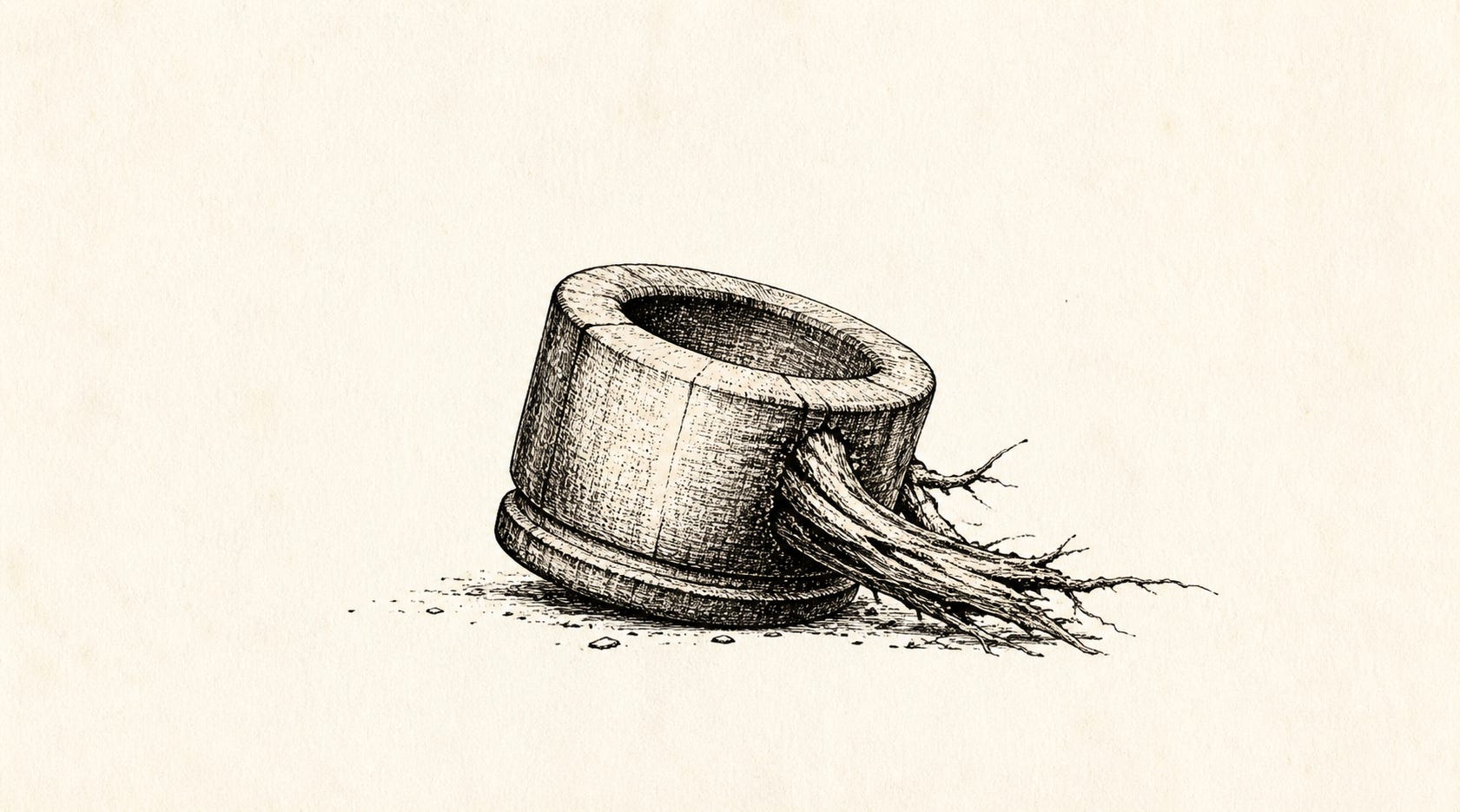
The rope went around his small waist. The other end she fastened to the heavy mortar used for pounding grain. It was old wood, darkened by hands, oil, and years. Its rim was worn smooth. Its belly was scarred. When it moved, it dragged with a low, stubborn sound.
“There,” Yashoda said, breathing hard. “Now stay.”
Krishna touched the rope with one finger.
The knot held.
Yashoda went back to her work.
For a little while, the house was quiet.
Then came the sound.
Scrape.
Pause.
Scrape.
Yashoda looked over her shoulder.
Krishna had turned onto his hands and knees. The mortar lurched behind him. His anklets chimed once, lightly, as though they found the whole affair amusing.
“Krishna,” Yashoda warned.
Scrape.
The child crawled towards the doorway.
The mortar dragged after him.
Scrape.
He crossed the threshold and entered the morning.
—
Beyond the house, the village was waking. Smoke rose from cooking fires. Cows nosed at their calves. Women filled brass vessels at the well. Children ran barefoot through the dust.
Krishna crawled past them all.
Some laughed.
Some called to Yashoda.
Some only watched, for there was something in the sight that stilled the tongue: the child’s small back, the rope tight around him, the old mortar striking stones behind him, his knees dark with earth.
He did not hurry.
He went as children go when they have chosen a direction no one else can see.
At the edge of the yard, the two Arjuna trees stood in their long silence.
No child should have cared for that gap.
No mother would have chosen it.
But Krishna crawled towards it.
The mortar knocked against a root.
He pulled.
It came free.
A woman dropped the pot she was carrying. Water burst across the dust.
“Yashoda!” she cried.
Yashoda came running.
Krishna had reached the trees.
He turned his head once, as though he had heard something inside the bark.
Then he crawled between them.
His small body passed through the gap easily.
The mortar did not.
It struck both trunks and stopped.
The rope tightened.
Krishna leaned forward.
The trees shuddered.
Not in their leaves.
In their roots.
The mortar held fast between the trunks.
Yashoda ran towards the trees, dust rising around her feet.
“Stop!” she cried.
Krishna did not stop.
He placed one hand before the other.
The rope cut into the soft skin at his waist.
The mortar groaned.
The trees shook again.
Birds burst from their branches. Leaves fell in green rain. Deep below the ground, roots that had slept through storm and summer began to tear.
The child pulled.
The chains were inside the wood.
For one breath, all Vrindavan heard them.
Not iron. Not bronze. Something older. A hidden binding strained to breaking.
Then the first root snapped.
The earth gave a hollow cry.
The second tree leaned.
The first followed.
Yashoda reached out both hands, though no hands could hold them.
The Arjuna trees fell.
They fell with the sound of a house collapsing, of thunder coming up from the soil. Dust rose in a great brown cloud. Branches broke. Birds screamed. Children ran. Cows pulled at their tethers and bellowed.
And there, between the fallen trunks, Krishna sat in the dust.
Still tied.
Still small.
The mortar lay behind him, half buried in torn roots.
He looked at the fallen trees as if he had only opened a door.
—
From the broken wood came light.
It was not fire. It did not burn the leaves. It trembled first in the cracks, then gathered where the trunks had split.
Two figures rose from the ruin.
They were tall, bright, and shaking.
For a moment, they seemed made of gold seen through water. Then the brightness steadied, and the village saw two young men standing where the trees had stood.
Their hair was loosened. Their hands were empty. Dust lay on their shoulders like ash.
They looked first at the sky.
Then at their own hands.
Then at the child.
The whole village had fallen silent.
Even Yashoda stopped where she stood.
The two brothers bowed.
Their foreheads touched the earth before Krishna’s dusty feet.
“Nalakubara,” said the child.
The first brother trembled.
“Manigriva,” said the child.
The second brother covered his face.
Names return differently after long punishment. A name once worn like jewellery may come back like water to the thirsty.
The brothers rose and circled Krishna, slowly, with joined hands. Once. Twice. Three times.
The rope was still around him.
The mark of it reddened his skin.
Yashoda saw the mark before she saw the light. She ran to him then, because she was his mother, and no wonder in the world could stop a mother from seeing where a rope has hurt her child.
She fell to her knees and fumbled with the knot.
Her fingers shook.
The knot resisted.
Krishna looked up at her.
“Ma,” he said.
The knot loosened.
Yashoda pulled the rope away and gathered him against her breast. His hair smelled of dust and butter. His cheek was warm against her neck. His anklets were quiet.
Behind her, the brothers stood with lowered heads.
Narada’s words had ended.
Their long standing was over.
They bowed once more to the child in Yashoda’s arms. Then they turned towards the north, where their father’s halls waited beyond sight, and walked away through the fading dust.
No one followed.
Some things released must not be called back.
—
That evening, the village gathered beneath the place where the trees had stood.
There were roots lifted like old hands. There were birds calling from roofs, confused by the loss of their branches. There was torn earth, raw and dark, where the hidden feet of the trees had been.
Men touched the trunks and shook their heads.
Women whispered.
Children crept close and peered into the hollow where the mortar had lodged.
Yashoda said little.
She held Krishna on her lap and would not let him crawl far.
Nanda looked at the fallen trees, then at the child, then at the rope lying in a coil beside the doorway. He picked it up once, turned it in his hands, and put it down again.
No one used it that night.
The mortar remained outside.
Its wooden belly was scratched. One edge had splintered. Dust filled the old grain scars. It looked smaller after the trees had fallen, as though its work had been too great for it.
Krishna slept before the lamp.
His hands were open.
Yashoda watched him until the flame burned low.
—
The grandmother stopped speaking.
The child beside the hearth had not moved.
Outside, the night trees leaned over the roof, and their leaves touched one another in the dark. The lamp gave a small sound in the oil.
“Were the brothers good after that?” the child asked.
The grandmother looked towards the door, where the wind had laid a little dust along the threshold.
“They had learned how long a tree must stand,” she said.
The child thought about this.
Then he looked at the lamp, at the black wick, at the coil of smoke rising from it.
“And Krishna?”
The old woman smiled.
“Krishna was still a child.”
She reached out and drew the blanket over his feet.
Outside, the trees listened.
Inside, the lamp burned low, and the room smelled of milk, ash, and wood.