

Fires of the Old World XIX — The Beggar God
A hearthlit retelling of Bhikshatana: Shiva as the beggar who enters the forest with an empty bowl.

When the lamp had burned low, and the house smelled of oil, warm milk, and cool stone, the grandmother drew the child closer beneath the cotton sheet.
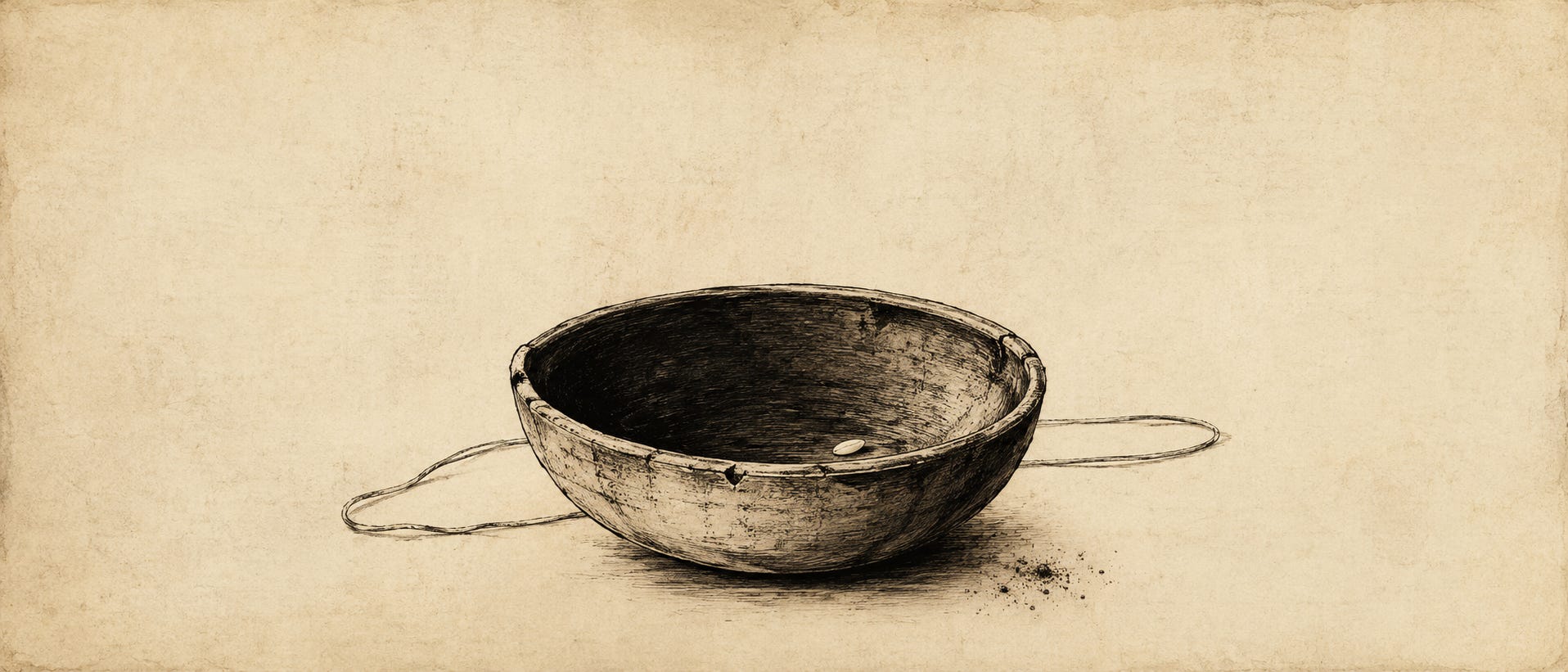
Outside, the night insects clicked in the dark grass. A bowl stood beside the lamp, empty after supper, with one grain of rice still clinging to its side.
The child touched it with one finger.
“Why do beggars carry bowls?” he asked.
The grandmother smiled, but only a little.
“Because some bowls are made to receive,” she said. “And some are made to reveal.”
Then she turned the lamp wick down, and told him this.
—
In the old forest, where the trees stood so straight they seemed to be listening, there lived a circle of holy men.
They had built their hermitages from bark, clay, and patient hands. They had gathered dry wood. They had tied the measuring cord between posts and altar-stones. They had planted lotuses in a little pond, and swept the ash from the sacred fires each dawn.
Their chants rose at sunrise.
Their fires smoked at dusk.
Their bowls were clean, their mats were straight, their rules were counted, and their names were spoken with respect in villages far away.
People brought them fruit.
Kings sent them cloth.
Travellers bowed before the forest and said, “There, surely, wisdom lives.”
So the holy men began to believe it too.
At first, the belief was no larger than a seed.
Then it grew roots.
Then it rose in them like a tree.
They thought the fire burned because they fed it. They thought the gods listened because they called. They thought the forest was holy because they lived there.
Even their silence became something they owned.
One evening, when the sun had gone red among the branches and the deer were moving softly through the grass, a stranger came down the forest path.
He had no sandals.
His feet were dusted white.
Ash lay across his skin as though the wind had touched him with the end of a burned branch. His hair was matted and lifted like a dark river caught in storm. Around one arm, a serpent lay coiled as quietly as a bracelet.
He wore nothing.
He was unclothed as fire is unclothed.
In one hand he held a begging bowl, dark and hollow, shaped like something that had once belonged to death and now waited for food.
He came without shame.
He came without apology.
He came as wind comes through a torn curtain.
The wives of the holy men saw him first.
They were grinding grain, washing brass cups, folding cloth, stirring milk over small fires. One woman had lotus pollen on her wrist. Another had ash beneath one fingernail. Another held a child half-asleep against her hip.
When the stranger stepped into the clearing, every hand stilled.
The pestle rested in the mortar.
The milk trembled but did not boil over.
The child opened his eyes and did not cry.
The stranger lifted the bowl.
“Alms,” he said.
His voice was not loud, but the leaves heard it.
One woman brought rice.
Another brought fruit.
Another brought curds in a clay cup, white and cool from the shaded pot.
He accepted everything and seemed to take nothing.
The bowl did not fill.
More women came from the huts. They stood close enough to see the ash on his shoulder, the dust on his feet, the small crescent of a smile that did not ask to be answered.
The holy men saw them standing there.
Something tightened in the clearing.
Not hunger.
Not fear.
Something older and uglier, with its hand on the throat.
The eldest sage stepped forward. His beard was clean and long. His cord was wound three times across his chest. He had measured altars, counted chants, fasted through storms, and made even his breath obey him.
“Beggar,” he said, “who are you, to enter our forest so?”
The stranger held out the bowl.
“Give,” he said, “and learn what you truly own.”
The sages looked at one another.
They heard mockery where none had been placed. They saw insult where only a bowl had been lifted.
The eldest took a handful of ash from the fire and threw it toward the stranger.
The ash rose like grey birds.
It touched the stranger’s chest and became another mark upon him.
He smiled.
A second sage took the measuring cord and snapped it hard across the ground.
“Stay beyond this line,” he said.
The stranger stepped over it.
The cord lay still behind him, thin as a dead vine.
A third sage whispered over a ladle of flame and hurled the fire into the dust before him.
The flame rose tall, bent once, and lowered itself near his feet like a lamp greeting oil.
The women stood silent.
The deer had stopped among the trees.
Even the little pond held its lotuses still.
Then the sages grew afraid of their own anger, and because they were afraid, they became cruel.
They went into the inner hut where old rites were kept. Their hands moved quickly. Their mouths shaped hard words. Ghee hissed in the fire. Seeds cracked. Smoke pushed low across the floor.
From the smoke came a tiger.
It leapt from the altar-flame with striped shoulders, bright eyes, and paws that struck sparks from the earth.
The women cried out.
The child hid his face.
The tiger sprang at the stranger.
He did not move quickly.
He placed the bowl down, touched the tiger between the eyes, and the great beast fell soft as cloth beneath his hand.
When he lifted his hand again, the tiger-skin lay across his arm like a garment that had always been waiting there.
No blood darkened the ground.
No wound opened.
The tiger’s roar had gone somewhere else.
The sages stared.
Their anger had not ended. It had only lost its first shape.
Again they whispered.
Again the fire bent low.
From the smoke came serpents, many and shining, with coil-scales catching the last light like little black mirrors. They poured over the ground, through the ash, around the stranger’s feet.
He picked one up.
It rested in his palm.
He placed it around his neck, and it lay there as calmly as a garland after worship.
The rest slipped away into the roots.
A younger sage seized a branch and struck the earth.
From the struck place came a small dark thing, fierce and twisted, with nails like thorns and a mouth full of old hunger. It ran at the stranger’s legs, clutching and biting.
For the first time, the stranger laughed.
The sound moved through the clearing like water over stone.
He lifted one foot and set it lightly upon the small dark back.
The creature froze.
Not crushed.
Not killed.
Held.
The stranger stood there, one foot upon the little body, tiger-skin over his arm, serpent at his throat, ash on his skin, bowl at his side.
Then he began to dance.
Not for triumph.
Not for display.
The ground knew the step before the sages did.
The trees leaned without bending. The pond shivered and kept its lotuses open though night had begun to fall. Sparks rose from the fire and hung in the air like listening stars.
His foot pressed down.
His other foot lifted.
His hair widened in the dusk.
The serpent watched.
The tiger-skin moved.
The bowl remained empty.
With each step, something left the sages.
Not their robes.
Not their chants.
Not their names.
Something they had kept clenched behind the ribs.
The eldest felt his measured breathing break.
Another felt the heat of shame rise under his beard.
Another reached for the cord at his chest and found his fingers trembling.
The dance did not accuse them.
That was worse.
It gave them nothing to fight.
At last the stranger stopped.
The forest was very quiet.
The little dark creature beneath his foot no longer clawed the dust. Its mouth had closed. Its eyes were wet and small, like the eyes of any frightened thing.
The stranger lifted his foot.
The creature crawled away and hid behind the ash-pit.
The eldest sage fell to his knees.
His hands, which had measured altars, now pressed into the dirt.
“Lord,” he whispered.
The word came out rough, as if it had scraped him clean on the way.
The others followed.
Some bowed.
Some wept without sound.
The woman with lotus pollen on her wrist picked up the begging bowl and placed it in the stranger’s hand.
It was still empty.
The eldest looked at the bowl, and his hand went to his chest.
His sacred cord was damp with sweat.
He loosened it.
For a moment, his fingers would not let go.
Then he placed the cord in the bowl.
It made no sound.
Another sage placed in it a garland of dry leaves. Another gave the ladle from his fire. Another took a pinch of ash from his own brow and let it fall.
The wives came last.
One placed rice.
One placed the little clay cup that had held the curds.
The woman with lotus pollen on her wrist placed a single petal in the hollow.
The child came forward with both hands closed.
His mother tried to stop him, but the stranger looked down, and she let the child go.
The child opened his fists.
Inside lay one grain of rice, saved from supper.
He dropped it into the bowl.
Then, at last, the bowl sounded.
Not loudly.
Only a small earthen note, like rain beginning on a roof.
No crown appeared.
No throne descended.
No sky broke open.
But every fire in the hermitage lowered itself at once, until each flame was steady and blue at the root.
The name moved through the clearing like a bell beneath cloth.
Shiva.
The old men bowed until their foreheads touched the dust.
The women bowed with them.
The child did not bow. He only looked at the bowl.
Shiva turned to leave.
No one tried to stop him.
The forest path was dark now, and roots crossed it like sleeping snakes. Once, his foot slipped on loose earth, and the clay cup knocked softly against the bowl. A thorn caught at his heel. He walked on, leaving a small mark in the dust.
Behind him, the measuring cord lay across the clearing.
No one picked it up.
By morning, the fires still burned, the chants still rose, and the lotuses still opened in the little pond.
But when travellers came, the holy men gave water first and names later.
When beggars arrived, no one asked who had sent them.
And beside the main fire, on a flat stone, they kept an empty bowl.
Only to hear, each dawn, what in them still clenched when the poor hand came near.
—
The grandmother stopped.
The lamp had burned lower. The room smelled of oil, cotton, and the last sweetness of milk.
The child looked at the empty supper bowl beside the flame.
After a while, he took the grain of rice from its side and placed it carefully in the hollow.
It made almost no sound.
But the grandmother heard it.
Outside, the insects went on speaking in the grass, and the lamp held one small blue root of fire.
For paid subscribers, I have added a Workroom note on the making of this tale: the bowl that began it, the danger of making Shiva too visible, and what had to be refused before the final version could stand.