

Leviathan — The Coiling Deep
A mythic hymn of sea, scale, sovereignty, and the futility of conquest.

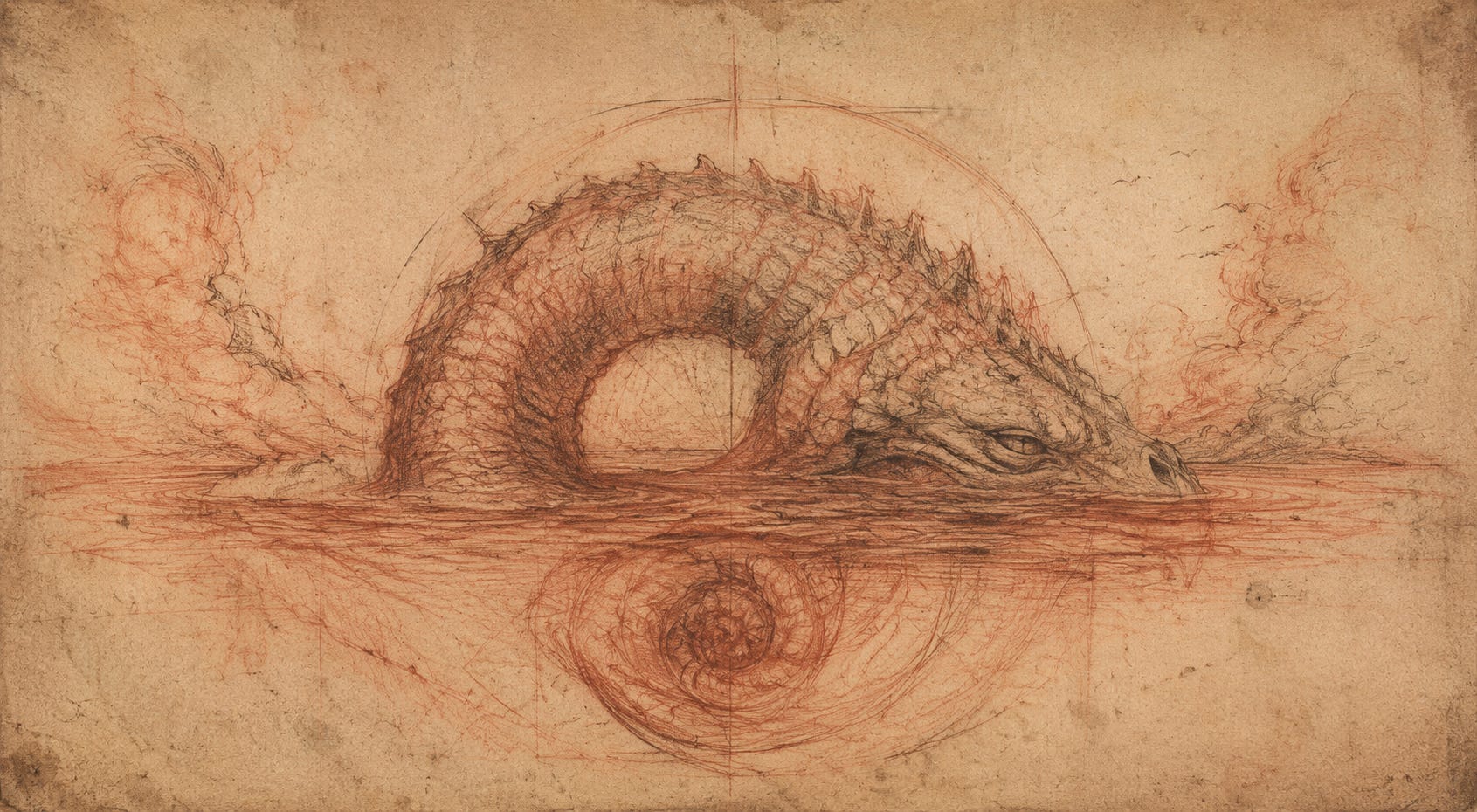
Leviathan is not treated here as a beast to be catalogued, explained, or defeated. It is approached as scale itself: the sea made body, the horizon made flesh, the old terror of a world that cannot be mastered.
⸙
The horizon was not horizon but body, a breadth of dark that feigned distance until the prayers of sailors unravelled against its silence. The sky itself bent downward as if scale had stolen dawn, as if every line the oar had carved through salt were answered by a listening coil beneath.
Men whispered names to their gods and found no echo. The water drank each syllable like marrow. The only reply was the long unbroken arc of flesh mistaken for sea.
Thus the horizon was prison, and the prison alive. Salt clung to the teeth of the wind, a taste like blood spat from storm-mouths unseen. Every mast was a reed upon its back, every sail a pale breath waiting to be torn. The tide kept its counsel as though guarding a wound too vast to name, as though every ripple concealed a jaw’s intent.
Listen.
The ocean does not move. It inhales.
In the stillness between two waves, a silence heavier than iron fell, and men felt their ribs drawn inward to a cavern of bone. The swell lifted not with the wind but with a heartbeat, a subterranean pulse threading every keel, bearing the weight of continents. No map could chart it. The line between sea and beast was unwritten. The compass turned inward, its needle dumb before the unseen coil.
Fishermen spoke of shoals of light flickering beneath the hull, but their shimmer was not fish, nor pearl, nor ember. It was the glimmer of plates vast as valleys, each scale drinking starlight and returning nothing. In that glimmer dwelt the dread of boundary dissolved: the knowledge that to look upon sea was to look upon skin unending, to confess that voyage itself was folly upon a single body.
Kings had marched to waters with fetters forged in temples, convinced conquest could still the horizon. But here, in the vast hush before storm, even the thought of dominion was swallowed. The prayers that fled sailors’ lips were not heard by heaven. They fell back into salt, consumed by the mouth that waited beneath.
And so the incipit was sung:
the sea is flesh,
the horizon coil,
and every prayer an oar striking hollow against eternity.
The hush deepened, a pause stretched taut as rigging in gale, until light bled across the surface — a gleam not born of dawn but of scale shifting in slumber. The silence heavier than iron did not lift. It shivered, cracked, and poured itself into vision.
Those who had thought themselves alone upon ocean’s breath now saw their prayers answered, not by heaven, but by the hidden back.
✦
It began as a gleam where no sun had risen, a silver wound across the night-water pulsing like a scar remembered by the world. Sailors thought it storm-light, lightning veiled in mist, yet no thunder followed — only a trembling in the tide, a shudder of depths recalling breath.
Clouds clung low, but their weight was false. What flickered was no storm at all, but the armour of a vast back turning in sleep.
The sea heaved not with wind but with a slow unrest, as if mountains moved beneath the keel, as if the keel itself were a splinter borne upon a shoulder vast enough to forget it. Masts bent as reeds. Rigging groaned like bones. Still the light returned, flashing again, nearer, broader, until men knew they looked not upon weather but upon scale.
The storm was a body.
The lightning was its skin.
What we call horizon is only the distance before the coil reveals itself. The line where sea and sky should part dissolved into a single immensity, a living wall that mocked the notion of boundary. Sailors gripped oars though no stroke could matter. Their prayers faltered into silence, for the gleam had become gaze.
Salt thickened in the throat, bitter as iron. Dread rose not from the waves but from within the chest, as though each heart had borrowed its rhythm from that unseen body. The storm that was not storm arched upward, and every man felt himself seen by something too vast to hunger, too endless to name.
Thus awe became suffocation. A jewel-shine that should have promised dawn now burned dread across the water, each flash a mirror of futility. In its light they saw not their sails but their smallness, not their voyage but their sentence.
The storm was flesh.
The glimmer was scale.
And the sea withheld its mercy.
The gleam widened until dawn itself seemed stolen, a wound of silver stretched into immensity, its edges dissolving into the horizon. What began as awe curdled into recognition: this was no single back, no passing arc of flesh, but hymn unfolding in breadth. Their dread became chorus, their silence psalm, for what shimmered was no storm-cloud but continent itself bending in coil.
⸙
Sing now the breadth no tongue can weigh, for the sea itself rose in testimony, its voice a psalm torn from the lungs of abyss.
The coil stretched beyond compass, a continent bent upon itself, a horizon clasped in living knots. Mountains were but barnacles upon its hide, valleys mere wrinkles where the tide had knelt to rest. What men had called world was only a shadow traced along its flank, a fragile engraving upon a body that needed no inscription.
Its breath was the swell.
Its silence was the trough.
Each inhalation lifted fleets as driftwood. Each exhalation crushed reefs into dust. Sailors knelt without command, for no sovereign voice could rival the thunderless hymn that issued from Leviathan’s turning. The psalm was not sung by men but by the deep itself: every wave a syllable, every breaker a benediction of dread.
Listen.
The earth has no edge, only the moment when flesh coils into sky.
The continents we walk are but scales half-buried, forests clinging like moss, rivers seeping like sweat from the body’s toil. To say land is to name the crest of a single fold, the brief rise of muscle before another arc begins. To say world is to forget we live already upon its back.
Kings who boasted of empires, whose banners claimed horizons, had never seen this breadth. Their fetters would not circle even the smallest curve of its skin. Their drums of war were no louder than rain upon its brow. In its silence, their triumphs rotted. In its turning, their maps became ash.
The hymn rose higher: not conquest but confession, not victory but awe.
For Leviathan is not slayer, nor guardian, nor beast to be weighed. It is horizon revealed as body, body revealed as endless coil. To glimpse its breadth is to know futility, to kneel without command, to breathe and call it prayer.
Thus the psalm closed in hush:
the continent is coil,
the horizon a rib,
and all life a brief adornment upon its tide.
Yet from that hush came dissonance. Men who knelt still carried chains in their holds. Awe curdled into resolve. Confession soured into decree.
If the horizon was body, they swore it must be bound.
If the continent was coil, they vowed to measure it with iron.
So they sailed with fetters like prayers of fire.
✦
Sovereigns came with chains forged in temples, hammered from the boast of cities, iron steeped in incense and oath. They declared the sea would be bound, the horizon yoked, the serpent bent beneath their law.
Drums thundered from shorelines. Banners bled in salt air. Priests cut their palms to stain the shackles with blood that swore dominion. The ships advanced not as pilgrims but as executioners, their prows sharp as verdicts, their sails swollen with the pride of conquest.
Yet the coil shifted, and the fetters fell slack before they touched the skin.
No clasp could measure such breadth. No ring could circle what had no edge. The chains sank like reeds, ringing once before silence swallowed them. Sovereigns shouted across the waves, but their voices dissolved into mist, their decrees answered only by the hush of depths too vast to hear.
The strike of hammer means nothing to the tide. The roar of kings is no more binding than gulls that wheel and vanish. What is empire but fleeting foam upon the back of a body older than stone, older than hunger?
Still they struck. Spears flew like sparks. Each vanished into the unbroken wall of scale, extinguished without sound.
Enough.
Leviathan’s breath rose, and the fleets tilted as if lifted upon a chest that cared nothing for their weight. Chains snapped not because they were broken, but because they were never placed. The futility was not defeat but irrelevance: the recognition that conquest has no place upon a horizon that breathes.
And so the hymn turned bitter in the mouths of kings. Their fetters returned as rust, their spears as silt, their banners as cloth for seabirds’ nests. The futility was sung not by them but by the waters, each wave a hymn of mockery, each hush a psalm of their undoing.
No sovereign can bind horizon.
No fetter can claim the coil.
The sea has no master.
The deep remembers nothing of chains.
Yet silence did not close. It deepened. An inhalation vast enough to draw in mountains broke beneath the ships, a pulse mistaken for calm revealing itself as prelude. The fetters clinked once against each other in the dark like bells tolling for their own decay.
What they thought sigh was ascent.
What they thought stillness was storm.
The serpent was not shackled.
It was waking.
⸙
The breath came not as wind but as upheaval, a heaving of the abyss that split night from itself. Clouds fled before it, torn like shrouds from the shoulders of the dead. The sea arched upward, not wave but rib, and the horizon itself bent, trembling as though to confess it had never been sky but coil.
Lightning flared where no storm had gathered, blue fire scrawled across a hide too vast to name. Thunder followed not from clouds but from within the water, a gong struck in the marrow of the world. Ships shuddered as twigs in a furnace. Sails whipped to tatters. Masts bowed like supplicants at the altar of dread.
Men who had shouted fetters now clung wordless to their planks, mouths filling with salt as though the sea itself sought to silence them.
Listen.
Breath is storm.
Exhale is tempest.
Sigh is ruin.
Each gust that clawed the sails was a heartbeat torn from the cavern of its lungs. Rain did not fall. It was spray from jaws too wide to close. The storm was not born of heaven but of coil, the horizon trembling because flesh had chosen to speak.
The sea revealed its psalm not in hymns but in rending. Shorelines far off broke apart as if struck by invisible hammers. Forests shivered though no wind touched them. The world trembled as though held in the throat of a single vast mouth.
Kings who once declared dominion now begged their gods to remember them, yet their voices were drowned in the storm-breath.
And still the coil rolled on, a turning that birthed hurricanes as casually as a sigh, a ripple that split heavens from their stars. No conquest could anchor against it. No altar could cage its song. The horizon was undone, not by destruction but by revelation.
It had never been still.
Only waiting to tremble.
Thus the storm sang itself into silence, leaving in its wake the hush of futility, the awe of breath remembered as thunder.
And when that hush fell, it bore not ruin but revelation. The waters steadied as though the body had returned to patience, yet the silence rang louder than any tempest. The storm had not passed.
It had spoken.
What remained was scripture not written in word or shrine but in endurance itself. The coil endured, immense and indivisible, horizon breathing still. Masts lay shattered, fetters sank, prayers decayed into silt, and yet Leviathan remained untouched, unscarred, unending.
From thunder’s after-echo came a truth vast enough to annul both conquest and despair.
The deep had spoken.
Its voice was silence.
✦
When the last mast fell quiet, when the last fetter dissolved to rust, what remained was not victory, nor ruin, but a breath that lingered — immense, unbroken, eternal.
Leviathan lay neither slain nor scarred. Its flesh was the horizon itself, its silence the scripture no hand could amend. The sea did not yield because there was nothing to yield. The coil was not enemy, nor ally, but being without end.
Men told of heroes who pierced its side, of kings who chained its jaw, of prophets who promised its bones would frame their temples. Yet every tale dissolved upon the water, swallowed before it reached the deep.
The truth was older than legend:
Leviathan does not die.
Its coil cannot be bound because there is no edge to clasp, no seam to stitch, no mouth to silence. Even the gods, whose names once thundered over mountains, gazed upon its body and kept their distance.
A wave breaks, and for a heartbeat one might believe the sea is severed. But when the foam recedes, the body still remains, vast and indivisible. So too the serpent: each strike, each chain, each prayer of dominion collapses into the same hush, the same futility.
To see Leviathan is to know the vanity of conquest, the smallness of crown and temple alike. Its eyes, if eyes they are, reflect nothing but the one who gazes, a mirror vast enough to drown empires. In its silence, kings unmake themselves. In its breath, banners fade to cloth.
It is not conquered because conquest is illusion.
It is not slain because death itself is too narrow to contain it.
Thus the revelation rose:
Leviathan endures not as beast but as tide,
not as foe but as horizon.
It waits.
It breathes.
It coils.
Never slain.
Never bound.
And when the revelation settled like ash upon water, the sea bore witness in stillness deeper than storms. The coil did not rise, nor strike, nor claim. It lay vast beneath, its silence a body spread wider than any crown.
Upon that silence the ships drifted — frail needles on the back of eternity.
What was storm had become loom.
What was revelation had become cloth.
Horizon stretched as living hide, bearing them as though they were only threads in a pattern it need not notice.
⸙
The sea lay calmed, yet not quiet, for its hush was the weight of a body at rest, vast enough that silence itself became storm. Across that breadth the ships drifted, frail as needles fallen upon a loom too wide for weaving. Their keels scratched threads of salt upon the dark hide, lines that vanished as quickly as drawn.
No mast pierced.
No prow scarred.
Each vessel rode upon the back of eternity and left no more mark than breath upon glass.
Men looked down and saw not water but ridges vast as mountain ranges, valleys sinking away into unmeasured depth. What they thought waves were the tremors of muscle. What they thought swells were the exhalations of lungs too immense to comprehend.
Yet Leviathan did not turn, nor strike, nor rise to devour. It bore them without care, as stone bears moss, as sky bears smoke.
We are smaller than we know.
To call ourselves voyagers is to mistake the stitch for the cloth, the mote for the storm. The ships moved like ants across a ribcage, like sparks across a cavern floor, each convinced of its purpose while the body beneath paid no heed.
Their banners trailed like threads unwoven. Their prayers thinned into whispers. Sovereigns who had come with fetters now begged only for passage, their spears forgotten, their chains rusting at the ocean’s floor.
Still the back carried them: patient, indifferent, eternal.
The sea did not answer, but neither did it sink them. Their journey continued not because they had conquered, but because the coil had not stirred.
Thus it was sung:
ships are needles,
the ocean the cloth,
and Leviathan the endless back
upon which all voyages are stitched
and unstitched.
And in that stitching, silence thickened — threads vanishing into cloth too vast to see, needles falling as dust upon a body that did not wake. The hush deepened until it seemed older than storms, older than their bones, older than names themselves.
The coil sank without sinking.
Breath folded inward.
The world itself bent its ear to listen.
✦
At last the sea folded into stillness, a hush so complete it felt older than sound. The coil sank without sinking, breath drawn not upward but inward, as though the world itself had turned to listening. No mast groaned. No oar struck. Only the slow exhale of tides settling into their own eternity.
The sailors dared not speak, for every word seemed a trespass, every whisper a stone cast into a temple’s well.
The horizon stretched unbroken, yet it was not empty. Beneath it, the body waited, vast enough that time itself bent around its silence. The stars above mirrored the glimmer of scales below, sky mistaken for flesh, flesh mistaken for sky, until the two were one unmeasured psalm.
Kings dreamt of chains, but their dreams dissolved. Priests carved prayers, but the salt wore them smooth. What endured was not conquest, nor creed, but waiting.
The deep keeps its own counsel.
It does not hurry.
It does not sleep.
It does not die.
Every wave that laps the shore is its breath disguised. Every calm its eyelid lowered. To walk upon land is still to tread its back, though we pretend otherwise.
To name Leviathan is already to diminish, to bind with syllables what cannot be contained.
Better to let silence speak.
Better to know that every voyage, every kingdom, every temple is but driftwood upon its patience.
Thus the hymn closes, not in thunder, nor ruin, but in reverence:
the deep does not die.
It only waits.