

Fires of the Old World XVIII — Desire Turned to Ash
A hearthlit retelling of Shiva, Kama, Rati, and Parvati — where desire becomes ash, and returns without a body.

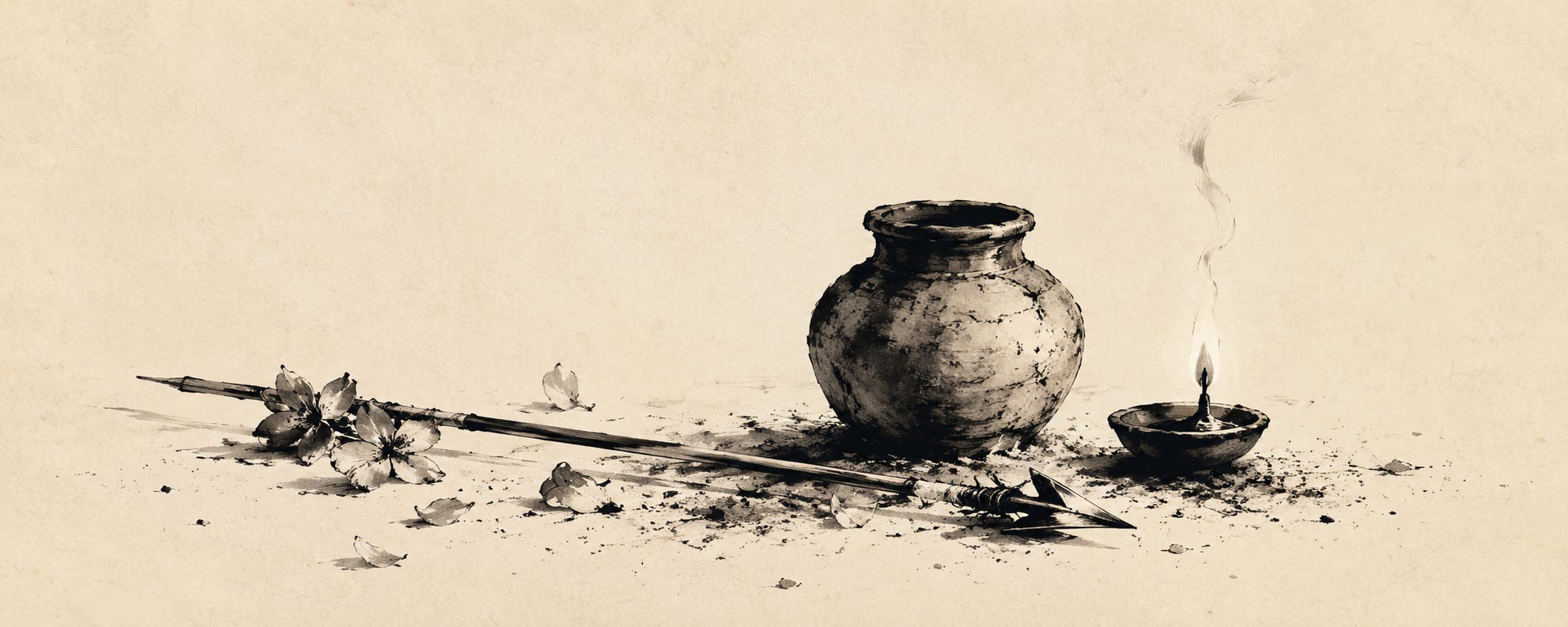
On the high slopes, where the stones stayed cold after sunset and the lamp oil smelt faintly of sesame, a child sat beside his grandmother and listened to the wind.
The old woman had placed a small clay vial near the flame.
“What is inside?” the child asked.
“Ash,” she said.
The child looked towards the dark window, where the mountain air pressed its cool face against the shutters.
“Whose ash?”
The grandmother turned the vial once between her fingers. It made the smallest sound against her ring.
“Come closer,” she said. “This is a tale for those who have felt spring arrive too sharply.”
—
In those days Shiva sat upon the mountain.
He sat where the snow did not melt, where the white peaks rose like folded hands, where the sky seemed too clear for any living thing to enter. His hair was matted. His eyes were closed. The crescent moon rested in the dark of his locks, and the river hid itself there, held in silence.
Around him, the stones forgot warmth.
A serpent lay at his throat without stirring. Ash marked his skin. The wind came near him and lost its voice. Birds crossed the air above him and did not cry.
Far below, people lit lamps and spoke his name softly.
Far below, mothers pressed children close when the earth shook.
For an asura had grown strong. His steps bruised the fields. His laughter darkened the halls of the devas. Spears had broken against him. Prayers had risen and come back thin. It was said that only a son of Shiva could bring the terror down.
But Shiva sat beyond longing.
He had gone where no hand could call him back. He had taken the world’s noise and laid it under ash. He had passed beyond hunger, beyond dream, beyond the bright ache of being seen.
Then Parvati came to the mountain.
She came without thunder.
Each morning she climbed the cold path with bare feet and a small brass lamp cupped in both hands. Sometimes she brought wild flowers. Sometimes she brought a lotus from a lower pool, its stem wrapped in a wet cloth. Sometimes she brought nothing but her own breath, white in the air.
She swept the stones before him.
She cleared fallen needles from the place where he sat.
She set the lamp down and shielded the flame until it caught.
Shiva did not open his eyes.
The snow lay still on his shoulders.
Day after day Parvati came. Frost bit her fingers. Wind pulled at her hair. Once a stone cut her heel, and she left a red mark on the pale path. She washed it away before she reached him. She would not bring blood into that silence.
Still Shiva did not open his eyes.
So the devas grew afraid.
They gathered where the sky was thin and the scent of smoke from human altars barely reached them. One still held a broken spear. Another had ash on his crown from a shrine burned in the night. No one spoke loudly.
“No weapon wakes him,” said one.
“No praise wakes him,” said another.
“No fear wakes him,” said a third.
Then someone spoke the name they had avoided.
“Kama.”
A hush passed among them.
For Kama was young in the way spring is young: older than memory, yet always arriving as if for the first time. He wore no armour. He carried no iron. His bow was sugarcane, pale and curved. Its string was made of bees, humming softly against one another. At his back he carried arrows tipped with flowers.
Mango blossom.
Blue lotus.
Jasmine.
Ashoka.
The flowers looked too tender to harm anything.
That was why the devas feared them.
Kama stood in a grove where the air was warm. Bees moved about him like small thoughts. His wife, Rati, held his wrist before he left.
“Do not go lightly,” she said.
“I never go lightly,” he answered, smiling.
She did not smile.
“The one you must wake is not a king in a garden. He is not a youth at a window. He is not a bridegroom in a bright room. He is the fire that remains when all lamps have gone out.”
Kama looked towards the north.
Already the mountain seemed to be watching him.
“The world has asked,” he said.
“The world asks many things,” Rati said.
Her fingers tightened around his wrist. The bees upon his bow grew quiet.
“Come back with your face,” she whispered.
Kama touched her hand once.
Then he went.
—
He did not go alone.
Spring went before him.
First came the warmth, low and soft, slipping under the snowline like a secret. Ice loosened in the small hollows. Water began to thread its way through stone. The roots of sleeping trees stirred without knowing why.
Then came scent.
Buds opened in the high air where no bud should have opened. Mango blossom breathed sweetness into the cold. Wild jasmine climbed over rock. The lotus Parvati had left beside Shiva’s lamp lifted its head, though its stem had already begun to dry.
Then came sound.
Bees gathered in impossible places. Birds returned to branches still rimmed with frost. Far below, deer raised their heads. Even the serpent at Shiva’s throat moved once, scale against ash, and became still again.
Parvati stood beside the lamp.
She felt the change before she understood it. The air touched her cheek like a remembered hand. A tremor went through the flame. The flowers she had brought opened all at once.
She looked into the trees.
Kama stood half-hidden among the blossoms.
He had chosen his arrow.
It was tipped with mango flower, green-gold and tender. The bees along his bowstring trembled. His fingers were steady, but his breath was not.
Before him sat Shiva, unmoved.
Around him the whole mountain leaned towards spring.
Parvati did not speak.
Kama lifted the bow.
In that moment, even the warm wind stopped moving.
The arrow flew. The world held its breath.
It struck the stillness.
For one instant nothing happened.
Then Shiva opened his eyes.
Two eyes looked upon the world.
The third looked upon what had entered.
Kama stood among blossoms, beautiful and afraid. His flower-arrow was gone. His bow hung from one hand. The bees no longer hummed.
Shiva saw him.
“Desire,” he said.
The word struck harder than flame.
Kama’s lips parted, but no answer came.
The third eye opened.
There was no anger in it.
There was no haste.
There was no apology.
Fire came from Shiva’s brow as dawn comes to a mountain, certain and terrible. It crossed the clearing without smoke, without crackle, without the hunger of ordinary flame.
Kama lifted one hand.
Far away, Rati cried out before she knew why.
The sugarcane bow fell.
The bee-string broke.
The flowers blackened in the air.
Where Kama had stood, ash lifted once, turned, and settled on the cold stone.
Spring recoiled.
The scents thinned. The birds fell silent. The buds held themselves half-open, unable to go forward, unable to close.
Parvati stood beside the lamp, her hands cold around its rim.
Shiva closed his eyes again.
The mountain returned to stillness.
But it was not the same stillness.
—
Rati came before sunset.
No one stopped her. Not deva, not wind, not serpent, not stone.
She climbed the path with her hair loosened and her feet bleeding through the dust. At the clearing she knelt where the ash lay. Her hands shook so badly that at first she could not gather it.
Then she took the end of her veil and folded the ash into it.
A little grey remained on her fingers.
She pressed those fingers to her forehead.
“Lord,” she said.
Shiva did not answer.
She bowed until her brow touched the stone.
“Give him back.”
The wind moved once between the trees.
“Give him back,” she said again.
Still Shiva did not answer.
Rati lifted her face. Tears had made lines through the ash upon her brow.
“He came with an arrow,” she said. “But he was not only the arrow.”
Parvati looked at her then.
The lamp between them trembled.
Rati held the gathered ash in both hands.
“He laughed before he answered. He touched every flower as if it might bruise. When he came into a room, even those who wished to be stern forgot their sternness.”
The clearing held her voice.
Even the devas did not breathe.
Shiva opened his eyes.
This time he looked not at Kama’s ash, but at Rati’s hands holding it.
“His body is gone,” he said.
Rati bent over the ash.
“Then let him live without one.”
The words were small.
They entered everything.
Shiva’s gaze moved across the clearing: the broken bow, the silent bees, the lamp Parvati had guarded, the lotus that had opened in the cold.
Then he spoke.
“He shall move where no hand can seize him. He shall pass where no gate can bar him. He shall trouble the old, the young, the wise, the foolish, the king, the beggar, the hermit, the bride. He shall have no body, and yet bodies shall answer him.”
Rati bowed lower.
The ash in her veil stirred.
Not like a man returning.
Not like a figure rising.
Only a warmth, faint as breath behind a closed door.
Rati felt it against her palms.
She began to weep without sound.
From that day, men called Kama bodiless. They did not always see him coming. They did not always know when he had entered. A flower, a glance, a scent at evening, a voice remembered after years — these were enough.
But on the mountain, something else had changed.
Parvati came again the next morning.
The path was colder than before. Her heel opened where the old cut had healed too thinly. She slipped once on a patch of ice and caught herself against a stone. The lamp nearly fell, and hot oil touched her wrist.
She did not turn back.
When she reached the clearing, she placed the lamp before Shiva and sat down upon the cold ground.
She did not sweep.
She did not arrange the flowers.
She did not ask to be seen.
She sat.
All day the wind passed over her. All night the stars sharpened in the sky. Frost gathered in the fold of her garment. The lotus beside the lamp bowed its empty stem, but the flame held.
Shiva sat.
Parvati sat.
The mountain watched them both.
Days passed.
Then seasons passed.
The world below continued in fear. The asura still walked. Doors shook at night. Mothers still woke before dawn and listened for distant cries.
But on the mountain, Parvati’s stillness deepened.
The devas came no more with schemes.
Spring did not dare to hurry the snow.
Rati kept Kama’s ash in a little clay vial at her breast, and wherever she walked, blossoms sometimes opened behind her after she had gone.
One evening, when the sky was the colour of cooled embers, Shiva opened his eyes.
Parvati was sitting before him.
Her lips were dry. Her hands were thin. The lamp she had guarded for so long burned low between them.
He looked at the lamp.
He looked at the lotus stem, empty now, but still lying where she had placed it.
He looked at her cut heel, scarred by stone and cold.
Then he looked at her face.
Parvati did not lower her eyes.
The mountain wind rose, circled them once, and became quiet.
Shiva spoke her name.
Not to summon.
Not to claim.
As one who had found a river beneath snow.
“Parvati.”
The lamp flame stood upright.
Rati, walking alone beside a grove, felt the vial warm against her breast.
She held it.
Inside, the ash was still ash.
But spring had remembered its road.
—
The grandmother stopped.
The child sat very still beside her, listening to the wind move along the shutters.
“What happened to the asura?” the child asked at last.
The old woman smiled, but not quickly.
“That is another tale,” she said. “A son was born, and the terror learned that even mountains may answer in time.”
The child looked at the little clay vial near the lamp.
“And Kama?”
The grandmother touched the stopper with one finger.
“Open a window in spring,” she said. “Hear a song from far away. See one flower bloom before the others. Then ask again.”
The lamp burned low.
Outside, the night air was cold. Inside, the room smelt of sesame oil, old wool, and smoke.
The grandmother wrapped the child’s blanket closer around his knees.
The vial rested between them.
The ash lay grey and soft beside the lamp.